
The Ghost Town of Sumbay
This would be the first time on our trip that we would re-cross a border. Despite the fact that it was the same border, the rules were not the same when crossing it the other way. When entering Bolivia from Peru, there were basically no rules except don’t bring in fuel. The main difference when re-entering Peru was the presence of the SENASA office at the border. This governing body deals with the movement of produce and animals and therefore would want us to declare any fruit and vegetables we had, as well as the cats. Bolivia is one of the most expensive countries to get pet exportation documents from, costing around $50 per pet, and as we only planned to stay for three weeks, we really wanted to avoid paying these fees. We decided to distract SENASA with some sacrificial onions while hiding our girls in cat bags in the back. People don’t generally search us much, something I attribute to the fact that we have so many windows. Unlike many other campers, you can see everything inside ours without opening the doors. It’s not like there’s much space to hide anything — there was enough, though, for two cats.
We left our lakeside paradise and were soon crossing over Lake Titicaca on the ferry to rejoin the main road. From here it’s about an hour and a half to the border, and while on the ferry we decided to put the cats in their bags. We wanted them to settle down and ideally go to sleep by the time we hit the border. We put them inside their two carriers, placing them in the back and stacking our boxes of clothes in front. Lexi howled for about half an hour, not used to being contained while driving, and Aimee settled down straight away. By the time we reached the border town of Copacabana, they were both silent and we rolled on past, to the border itself.
The Bolivian side took a matter of minutes. We stamped our passports, cancelled our vehicle documents, and changed our money. The rickety gate was wheeled out of the road and we drove through no man’s land to Peru. This was the moment of truth. We had had to balance the time on both our Peruvian and Bolivian visas. There was no set information about how much time we’d get when we re-entered. It was possible they’d only give us the remaining 24 days of our visa and, with my parents coming, we had to assume the worst-case scenario and make sure we had enough time to get in and out within that window. We had carefully planned to cross on this day as it gave us time to get to Arequipa and then back to the border. The only downside was that by waiting for the opportune time to enter Peru, it ate into our Bolivian visa. This was the problem — you can never be sure exactly what will happen.
That point was proved at immigration: I was given a 60-day visa, while Lee only got 30 days. A perfect example that it was all down to who you got on the day. At least now we didn’t need to rush out of Peru, and we relaxed a little. The vehicle documents were even easier. After showing the office our old document, they couldn’t even be bothered to get out of their chair and check the car. They copied down the old details onto a new piece of paper and waved us on.
Back at the car, a lady in an ominous green uniform loitered nearby. She asked us if we had any pets, vegetables, or fruit. We gladly waved our sacrificial onions at her, which she apologetically confiscated before leaving us alone. She didn’t even ask to look in the van and, just like that, we were free to go. It had been a lovely easy crossing, and now we could sit back and enjoy the drive north after pulling over just up the road to release the cats.
We decided to head to another lakeside spot just past Puno, where we could enjoy a quiet night and put some distance between us and the border. It was about a three-hour drive and, as we continued on, I decided to be responsible and buy us some insurance while we motored along. We had driven this road before, but this time I noticed there was a SENASA checkpoint just south of Puno that, while we had driven past it heading southwards, only checked cars travelling northbound. Recent comments about this location suggested that it was pretty lax and we debated whether to hide the cats again. In the end, we decided it would be fine at this time in the afternoon. We were wrong.
We reached the checkpoint and, to our dismay, were waved to the side. The first thing they asked us was whether we had pets. We could have said no, but if they opened the door or looked through the window, they would see Aimee sprawled across the rear seats. What ensued was a good half an hour of arguing. We said the border didn’t care. We said we wouldn’t be here long. We said we had all the up-to-date vaccines anyway. The guy was not amused. Eventually, though, he grudgingly waved us through. The paperwork was probably not worth the trouble of processing some cats. We counted our lucky stars and drove through Puno and out the other side. Here, we again ran into trouble.
This time a policeman pulled us over on his bike, telling us we were breaking the law by not wearing seatbelts. Much like the SENASA official, he was completely correct. We tried to explain that they were broken and we couldn’t find replacements yet. He wanted to see our insurance, which I had happily just bought an hour ago and was able to show him. Then his colleagues called him away and he decided we weren’t worth the hassle, letting us go. Another lucky escape, and now, with the sun nearly set, we continued on the last part of the way in the dying light.
By the time we reached the lake, after driving 10 km of dirt washboard road out of the town, it was totally dark. We parked up wonkily on the side of the lake. It had been a long day, but we were here and we could now make our way leisurely across to Arequipa to meet my parents in a couple of days’ time. We enjoyed a mainly silent night, apart from one creepy car that parked on the road above us and shone a torch straight at us for about ten minutes before driving away.
The morning light revealed that we had really not picked the best place to park. One of the reasons not to arrive in the dark is that it’s very hard to level the van or pick the level spots without being able to clearly see the surroundings. In the light of day, it was clear we should have parked a few metres further back, where we wouldn’t have spent all night rolling into each other.

There wasn’t much point doing anything about it now, as we had decided to keep pressing west. I wanted to be as close as possible to Arequipa, eliminating any last-minute car dramas, and so we decided that we would spend a night or two in the ghost town of Sumbay, just two hours above Arequipa. From there, it was an easy downhill drive to reach the airport, where we would collect my parents in a few days’ time.
As we didn’t have much in the way of fruit and vegetables, we headed back down the dirt road and into the nearby town to visit the market. We were about to stock up on a few basics when we realised we had very little cash — and we needed fuel. Instead of buying food, we went to the petrol station first in case they didn’t take cards. We didn’t need to end up with vegetables but no fuel, and there was no cash point here, as a quick walk around the town confirmed.
In Bolivia, we had always paid for fuel — and indeed most things — in cash. Card payments were often not accepted unless you were in major cities, and so we always carried cash. Back in Peru, things were a bit easier and we had no problem buying fuel with a card, even if it was quite expensive, at the local station. Now that was sorted, we went back to the market and stocked up on some food before continuing on across the barren altiplano towards Sumbay.
The main road runs across the mountains between Puno and Arequipa at a steady 4,000m. Instead of continuing on to Arequipa, we turned right and headed a short way up into the mountains. A small, unloved dirt road leaves the smooth tarmac and heads down into the valley and the ghost town, where apparently there is only one resident. It’s a rough, loose rock road and we bounced our way slowly down until the buildings of the town came into view. Apparently, most people choose to park at a flat area in front of the church, and we pulled up here too.

It wasn’t too long before we met the resident. There was also one other guy with him and several dogs. They really did seem like the only people there. Every building was shut and padlocked, some ruined completely. Grass grew down what were once roads and the only thing that looked like it still worked was the train track. We asked if we could camp there. He struggled with our Spanish and we struggled with his too. We eventually ascertained that it was fine. He offered to show us the cave paintings that were there — one of the reasons people came. We said we’d like to look tomorrow and he gave us an uncomprehending toothless grin before ambling off into the untamed grasses and fallen boulders. It seemed like he lived a little out of the main village, up on the hill, as if the abandoned village itself was not lonely enough.

It was no surprise that the night there was deathly still, and we slept well despite the cold. We had arranged to go and look at the caves at midday but, as ever, nothing happens when you arrange it. Several hours later, he appeared and gave us the key from around his neck, hanging on a piece of string. He charged us a small amount each for access and walked us down to the gate of another road, waving us down it.
We walked slowly along this dirt track, the railway weaving its own path through the valley to our right. At over 4,000m, it didn’t take much of an incline to leave us out of breath. After around a kilometre or so of steady walking, we reached the end of the road, which halted above the valley in a small circular dirt parking area. A sign announced that we had arrived in the correct spot and a small footpath descended down over the train tracks and into the valley.

We climbed down a rocky path between boulders that dropped sharply to a small river. I could see the appeal of sheltering down there, out of the wind and next to the water, as some people clearly had done over 8,000 years ago.
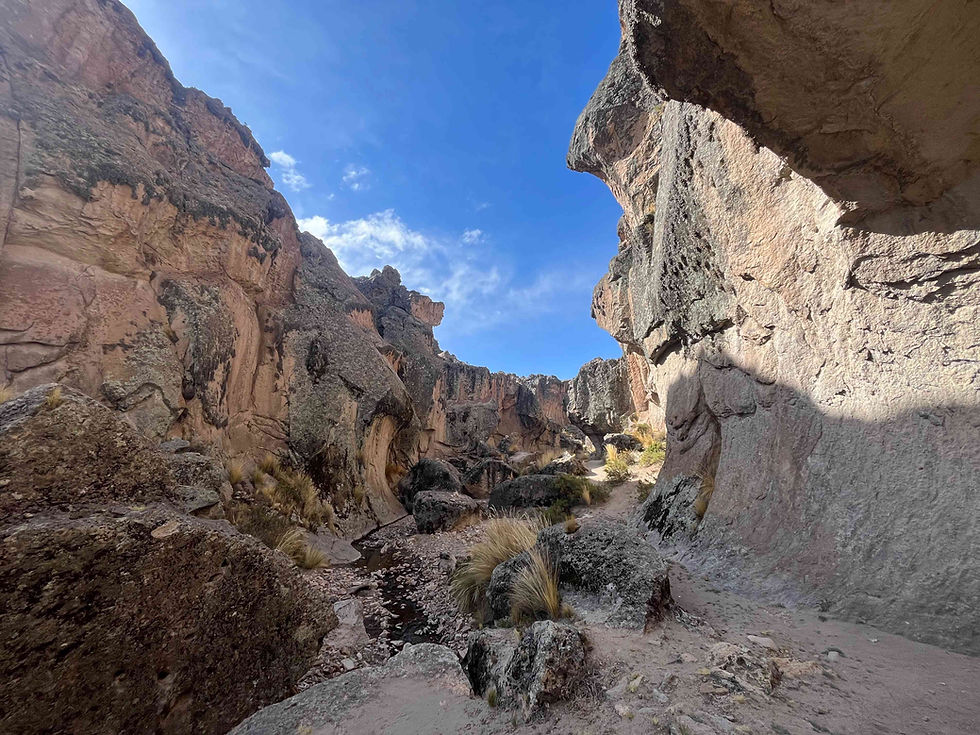
A little way up the stream, a cliff overhang with metal gates housed the cave paintings. It was possible to have a pretty good look at them from outside, but we didn’t mind paying a small amount for the keys that let us get inside and up close. It seemed the locals didn’t have much faith in them being preserved, having encased the whole rock overhang in metal gates and then double padlocked it.

Inside, on the rear walls, several animals — mostly vicuñas — were etched into the stone. I’m not sure of the significance of the number. Was it how many they’d seen? Or killed? Or owned? Did they just want to practise drawing vicuñas? Whatever the reason, it was almost beyond comprehension to imagine another human standing right where we were eight millennia ago.

Back at Ruby, I debated whether to do some work on the van. Our front suspension needed raising, especially now that the rear sat higher after the welding work in La Paz. It seemed like a good idea to do this before she was required to carry the extra load of people and luggage. However, Lee pointed out that if anything went wrong here, it would be a bit of a disaster, so we decided to wait until we were nearer civilisation before attempting it. I didn’t want to have to try and explain to my parents that I wouldn’t be picking them up from the airport because the camper was in pieces on the floor of a ghost town.
We spent one final peaceful night in the square outside the church, deciding that tomorrow we would drive down and park somewhere for free in Arequipa. We needed to be at the airport for around 10:30am, so it made sense to arrive in the city the night before. We had planned to leave late in the morning, but Aimee did her traditional vanishing act, meaning we didn’t get away until late afternoon.
We arrived in the twilight and wound our way past the airport and a military base to camp on a small dead-end road, tucked out of sight for the night. We were only half an hour from the airport for the following morning, and I couldn’t have been more excited.

Comments