
The Chilean Side of Tierra del Fuego
We drove along a surprisingly good dirt road. It was narrow for sure, but pleasantly free of washboard and potholes. We cruised along in the sunshine, heading for Lago Deseado. After an hour or so we came across a group of young guys, laden with huge backpacks, walking along the road. They desperately stuck out their thumbs. We certainly couldn’t take all of them, but we had barely seen another car and didn’t feel like we could just drive past. We explained that we didn’t have space for everyone, but that we could take two. They were happy enough with that and so, after some rearranging, two of them piled their enormous backpacks into the back and squeezed in behind them.
They told us they were students in their final year of university and that they had been friends since school. Every year they all went on a two-week camping trip together. I thought that was pretty awesome — how many people stay close to their school friends and still make the effort to commit to two weeks together after all that time?
It was still a fair drive to reach the lake. After another hour or so, we dropped down a series of hairpins and continued the final stretch alongside the river. We passed one smaller lake and then emerged at the edge of Lago Deseado. The guys hopped out and waited in a large lay-by, hoping their friends would eventually turn up.
We considered our camping options. There was a lovely spot right on the edge of the lake if you turned down a small side track. Lee went to scout it out. He reckoned it was a bit wet, but that we’d be all right. We turned down the track, drove a few metres and Ruby promptly sank into the peaty bog up to the exhaust pipe.
Well, at least we weren’t alone. We asked the hitchhikers for a push, but it soon became clear we were far too stuck for that. We got out the shovel and took the recovery boards down from the roof rack. Then, as luck would have it, a pickup drove past. We waved. They carried on. A few seconds later we heard the truck stop. It reversed back towards us and asked if we needed help. We gladly accepted. Our trusty tow rope was dug out from the recesses of the engine bay and within a few minutes they had hauled a dripping muddy Ruby out of the quagmire. We thanked them profusely and they drove off.
The sensible thing now would have been to camp in the lay-by. Lee, however, had his sights set on the scenic lakeside spot. He promised that, with a few minutes spent laying down nearby wood, we’d sail straight across into the perfect campsite. I didn’t want to end up stuck in the bog again as the light faded, but he was very determined.
After some time he had built us a little wooden road. We laid down the recovery boards too. I stepped back and let him at it. Ruby hit the logs and sticks at speed. Everything snapped, the wheels spun and slid. Then suddenly they found purchase on a stray piece of wood and she careered sideways out of the bog, over a recovery board and onto the drier patch of grass. We had made it — just.

We levelled the van using the recovery boards since they were already out. The guys managed to find a local to collect the rest of their group and asked if we minded sharing the campsite, since it was about the only tent-friendly spot around. They pitched their tents and we sorted out the van.
Then it began to rain. Hard. We got out the awning so they could sit somewhere dry and handed around hot water bottles. We huddled beneath the awning around our little table, drinking whisky and chatting until the evening finally wound down.
The next day they headed off to try and hitch a ride to the end of the road. We decided that the effort required to reach this spot justified staying at least two nights. It was absolute tranquility.
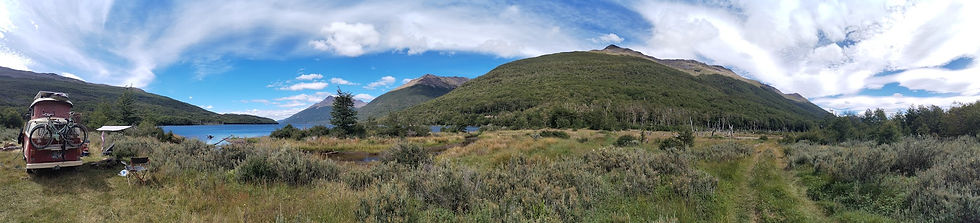

The rain had stopped and we hoped the ground might dry a little. Lee spent some time gathering extra wood and reinforcing the broken remains of his “road”. Nothing was safe. A broken road sign was added to the pile. A random sheet of metal. Several small trees.

The bog itself wasn’t huge, but it was incredibly soft and wet. Even where we were parked, the van had sunk several inches into the mushy ground that had initially appeared dry. After quite a bit of preparation, Lee was satisfied that tomorrow we’d drive straight out without issue.
Towards the end of the afternoon, another car arrived behind us. It drove straight down Lee’s carefully constructed log road and then sat there for a while before the driver decided they wanted to leave again. Lee’s face became a picture of complete anguish.
He twitched aside the pop-top curtain and watched them reversing.
“They’re going to ruin it! I had it perfect!” He lamented.
There wasn’t much I could say. They almost certainly were about to ruin it.
Sure enough, we soon heard the high-pitched scream of spinning tyres. A few minutes later the driver appeared asking if we had a shovel. We handed it over. A disheartened Lee wandered out to inspect the damage to his 'road'.
In fairness, they hadn’t ruined the road too badly. Mainly because they had missed it entirely while reversing and sunk the car into the bog beside it instead. We tried pushing. We tried digging. We gave them our recovery boards, which I instantly regretted as the guy shoved one under the wheel at a forty-five-degree angle and his partner floored it. Naturally this achieved absolutely nothing except beginning to melt the boards.
“You can’t drive like that,” I told her. “You’re just destroying them and it won't work.”
Suddenly I found myself behind the wheel instead. Honestly, I don’t think I could have done a worse job even if I’d never driven the car before.
The man was agitated and just a little bit stoned. It wasn’t even his car.
“Does this thing not have four-wheel drive?” we asked.
He didn’t know.
Then another camper happened to pass by. We flagged them down and asked for a tow. With the boards in place, tow ropes attached and me driving, we finally dragged the car out of the bog. Lee stood mournfully over the broken sections of his carefully constructed road.
“That took me hours…” he said sadly to the driver.
The driver looked simultaneously apologetic, grateful and relieved. He asked if we smoked weed. We declined. He grinned and shoved a huge handful of marijuana into our hands before driving off.
The other camper wandered over as we stood there holding our unexpected gift. We thanked them for helping and it turned out they were very enthusiastic about the idea of a spliff. In exchange, they traded us two large cans of beer. I suppose, in the end, everyone got something out of the situation.
The following day we decided it was finally time to leave. Lee had added yet more wood to the damaged sections of the “road”. We were preparing to depart at a leisurely pace until I stepped outside and saw dark black clouds swelling behind the mountains. A drop of rain hit the freshly dried awning.
I jumped back inside.
“We need to go!”
“Why? What’s up?”
I pointed at the clouds gathering in the valley behind us.
“Oh. Shit.”
That was enough motivation. We roughly threw the last few things inside as the rain began to fall. Lee jumped into the cab and started the engine.
“Let’s just get out of here. We can sort the rest out once we’re back on the road,” he said.
I agreed.
He turned the van around while I picked up the recovery board we had been parked on, now completely sunk into the mud. I walked ahead and laid it down in what I judged to be the optimal position. Lee accelerated, slipped slightly and then, within seconds, made it out in one piece.
Several hours of log positioning had given us a remarkably drama-free escape. We breathed a sigh of relief, strapped the boards back onto the roof rack and continued onwards.
One more mountain pass stood between us and the southernmost point on the Chilean side. The road was in surprisingly good condition and, with the cold temperatures, we had no trouble slowly crawling up and down the other side. The scenery was beautiful, silent and remote. We saw perhaps three cars during the entire hour-and-a-half drive. We stopped and waved when we saw the group of lads standing at the roadside, still trying to hitch a lift north.
At the bottom of the pass we reached the river. This river flows out of Lago Fagnano — the enormous lake that nearly splits the island in half and beside which we had camped near Tolhuin back in Argentina. A vast river runs west from it, crossing into Chile before finally reaching the sea. We crossed it here at the foot of the mountains and followed it towards the coast and the lone building known as Caleta María. As the fjord opened up ahead of us, we were greeted with yet more stunning mountain views.
At the end of the road was a small car park already occupied by another camper. The owner told us they were planning to do the boat tour the following day and that there were still spaces available. Apparently, once the boat is full, the tour works out cheapest at around $100 per person because you are effectively paying for the entire boat regardless of passenger numbers. We were tempted. It sounded like a miniature Antarctica experience — probably the closest we would ever get.
In the meantime, though, we wanted to visit the colony of king penguins visible on the beach nearby. To reach them, you had to cross the final shallow delta of the river we had been following. The easiest method seemed to be removing our shoes and socks and wading across to the small island. Needless to say, the water was absolutely freezing.
Once across, we walked over to the penguins. Behind them a hanging glacier loomed above the river and the whole setting was stunning. The penguins themselves seemed entirely unbothered by our presence and we were able to get surprisingly close.

Some were moulting and one in particular reminded me strongly of somebody’s glamorous aunt with a fondness for fur coats and feather scarves. She stared at me loftily, apparently offended by my judgement of her ragged appearance, which genuinely did resemble the remains of a battered feather boa.

Back at Ruby we bumped into the other campers again. The guy was outside gutting a sizeable trout he had just caught in the river. We asked about the boat tour, but he told us the remaining spaces had already filled up, removing any need for a decision on our part. Instead, we decided to spend the night there since the weather was surprisingly calm and then start heading north again the following day.
As ever, it was the infamous 3am wind that got us. Even though we had parked facing into it and sheltered slightly behind the other camper, the gusts made sleep impossible. So we headed back out in search of a more sheltered place for the following night.
The official southernmost point here is currently a military road under construction and so, purely so we could say we had been there, we drove down to the end of the road and the barriers. The aim is eventually to build a route over the next mountain range connecting this area directly with Ushuaia at sea level. That would give Chile far easier access to the Beagle Channel, since the current diversion is enormous. The project has apparently been under construction for years though and still seems nowhere near complete.
The useful thing about driving down there, however, was that the change in direction and the opening up of the valley offered much better wind protection. We found a sheltered spot and went for a short walk to a nearby viewpoint.

I could easily have stayed in this region longer. It felt so untouched, so beautiful and so quiet.
In the back of our minds though, we were always aware of the seasons slipping away from us and knew we needed to continue north. So the next morning we reluctantly said goodbye to the mist-shrouded peaks and headed back up the mountain pass once more. We stopped briefly to look for beavers and, although we saw plenty of evidence of them — shredded trees, dams and felled branches — we never actually saw the animals themselves.
We decided to spend the night nearby after pulling over with a puncture. Even though we were perched halfway up the pass in a valley, the wind was manageable. Rain lashed the windows and Ruby sat noticeably lopsided as there was absolutely no chance I was changing the tyre in those conditions. Instead, we made hot chocolate and enjoyed being warm and dry inside.

Once again, though, the 3am wind arrived in full force. We woke to the van rocking violently and the pop-top swaying ominously overhead. It was not a peaceful night and we were both rather worse for wear when we finally set off on the long drive out of the region the following morning. We passed the lake once more and climbed the second pass, stopping briefly at the mirador before continuing onwards.
Eventually we rejoined the road from the border crossing and headed towards the first tiny settlement of Camerones. There was actually a shop there. We marvelled at the prices. Even in a tiny shop in the middle of nowhere, things were still dramatically cheaper than in Argentina.
We had hoped to stay in the village that night, but there was very little wind protection and by this point we were absolutely determined to get a proper night’s sleep. So instead we continued around the bay towards Porvenir. All along this road are refugios — small shelters built for the many cyclists apparently insane enough to ride this route. Some are large and modern, complete with Wi-Fi and even stoves, while others are little more than dirty sheds I can’t imagine anyone voluntarily sleeping inside.
We continued driving along the coast towards one particular refuge we hoped might offer enough shelter to park behind. Although there was no wind at the moment, we had already been caught out too many times.
When we arrived, near the king penguin reserve, there were already two other campers parked outside: a small hire van and a larger converted Sprinter. They seemed to be using the place as a free campsite with little interest in the refuge itself. After looking at the building and deciding it wouldn’t really shield us from the wind, we began wondering whether we should simply sleep inside instead.

The couple in the smaller van were already using the refuge. We got chatting and they explained that they only wanted to cook inside because it was more spacious than their van. We explained that we only wanted somewhere to sleep and so we agreed to share it.
Inside, the refuge was surprisingly clean and spacious. It looked fairly new and even had its own pit toilet. The stove was sadly unusable because someone had stolen the chimney, but otherwise it was excellent. A ladder led up to a large sleeping platform above the main room — more than enough space for a double bed. Once the others had finished cooking, we carried our mattress across from Ruby and set it up upstairs. It was actually incredibly cosy.
We left the cats inside Ruby with the roof down, since the refuge doors had no catches and could easily be pushed open. We figured they’d be fine for one night.
That evening we climbed into our makeshift bedroom and enjoyed the rare luxury of proper walls and insulation. Even though it wasn’t windy when we went to bed, things changed later in the night. I woke briefly as the wind howled around the refuge — but this time I simply rolled over and went back to sleep. No lying awake wondering whether a solar panel was about to smash through the roof onto my face.
After a much better night, we repacked the van and emptied the last of our jerry cans into the fuel tank. Porvenir was still several hours away and I hoped we had enough diesel left to make it. It was definitely a good thing we had bought all that extra fuel back in Argentina because there was absolutely no way we would have managed otherwise. Even after adding another twenty litres, the fuel gauge barely moved. We just had to hope the final stretch wouldn’t involve too much headwind.
Unfortunately, unlike the previous few days, both the road and the wind became dramatically worse. The section we had driven the evening before had clearly been recently graded, which explained why it had been in such good condition. We met the grading vehicles shortly after leaving that morning and, unsurprisingly, the road deteriorated significantly once we passed them. Combined with a strong headwind, it was hardly ideal for fuel economy, but there wasn’t much we could do except keep steadily driving.
Eventually, with less than half an hour remaining before Porvenir, we caught up with a familiar camper. Carlos and Marce — our fellow slow travellers — were here too. This time, however, they really were travelling slowly, so after exchanging waves we overtook them and pressed onwards towards the petrol station.
We arrived almost on fumes and happily filled the tank despite the painful Chilean fuel prices. Now only one obstacle remained: the ferry. We had heard that sailings were often delayed by rough weather and, given the gale-force winds that day, we assumed it probably wasn’t running. Nevertheless, we headed to the port to find out.
The other complication was Ruby herself. Ferry prices varied enormously depending on the type of vehicle. Campervans cost more than double the standard vehicle rate. Because of Ruby’s small size, we were usually classified as a normal car or truck. I had already calculated that if they charged us at the cheaper rate, this ferry would cost exactly the same as driving all the way around to the other crossing. If they classed us as a campervan, however, it would be massively more expensive. There was no real way of knowing beforehand and I was fully prepared to argue that, at under five metres long, Ruby should not count as a camper.
The suspense continued when we reached the port and were told the ferry had been cancelled. Tickets couldn’t be purchased until sailings resumed. We were simply told to “check later”, which was about as informative as it got.
A lorry driver parked nearby assured us it would start running again at 6pm. Since he was driving commercially, we figured he probably knew what he was talking about, so we decided to wait it out. Every so often we wandered back to the ticket office to see if it had opened.
Then, around six in the evening, everything suddenly sprang into life. Men in high-vis jackets began walking down the queue. It looked like they were checking tickets. Instantly there was a mad rush for the office. We ran over too, terrified of missing a place on the ferry. Sure enough, the ticket office was finally open.
A few minutes later, after the woman behind the desk had inspected a photo of Ruby, she processed us at the cheaper rate. We jogged triumphantly back to the van, presented our ticket and drove aboard.
With the delayed departure we wouldn’t arrive on mainland Chile until around 8pm, but we were just relieved to be leaving the island that night rather than spending hours stuck at the port.
Even so, I felt genuinely sad watching Tierra del Fuego disappear behind us. The place had completely surprised me and I had loved every minute of it. Even after spending more than a month there, it still felt far too short.


Comments