
Faro San Isidrio: Chile's Southernmost Tip
We drove out of Punta Arenas, heading towards the last outpost of civilisation at the southern tip of mainland Chile. This is the furthest south you can go without taking a boat. We drove a pretty coastal route down, with the sea to our left and forests to our right. We passed through the tiny town of Tres Puentes, assessing the camping options as we went.
We opted to stay next to the road by a small stream. We hoped the wind wouldn’t be too strong here, but as always, you never really know until it’s too late. Since our pop-top disaster in Tierra del Fuego, we had managed to bodge the roof bars back together by shoving plastic connectors inside the broken bars and riveting them in place. It was working, but it wouldn’t withstand much force.

Once we had parked up, I got to do my favourite thing: opening Amazon packages. Our new mattresses were uncurled and released from their vacuum packaging. They lay in the sun, slowly fluffing themselves up while we got the rest of the van organised. We had gone for a bit of an upgrade this time; 3" memory foam as opposed to our old 2" mattress. As the years have gone by, we've both found that the old thin bed just wasn't enough and we often woke up with sore necks or aching hips. That night we crawled ecstatically into our new luxury bed. It was exciting to be able to lie on your side and not feel the wooden board underneath anymore. The wind stayed calm and we slept well.
Feeling rested, we set off the next day for a hike. We drove a short way further down the road. It had rained in the night and the road was thin slurry. It was also surprisingly busy. Even though we were out here in the middle of nowhere, it seemed plenty of other people also fancied a Sunday hike along the beach. We parked up in a long line of cars and pulled on our walking boots. For me, that was just a normal pair of trainers as my proper boots had completely fallen apart hiking to the glacier. It was far too expensive to even think about replacing them here and so I hiked in my very non-waterproof trainers, picking my way through the slurry and hoping it would dry out further along.
It’s not a particularly long walk for most people, although it can be extended for many miles by staying in refuges if you have the motivation and the equipment. Most people, however, simply hike to the lighthouse at the end. This is a proper one of bricks and mortar, not the wire frame with an LED stuck on it that seemed to be the trademark of Tierra del Fuego. It’s about 5km down the beach to get there, perfect for a leisurely Sunday stroll.
The walk itself has no real path; you simply walk along the beach. On the plus side, that means there’s no mud. On the other hand, walking along loose rocky pebbles for this long is far more tiring than following a regular footpath. As we walked, we watched fishing boats gliding past in the still water to our left while, in the forest on our right, we got lucky and spotted a kingfisher posing for the perfect photo.
The whole place reminded me strongly of Scotland. The vast grey waters, hanging lichen and quiet, windswept scenery felt oddly familiar. This was particularly true as we neared the end. Here the route turned inland and began to climb. We started to get beautiful views on either side down to immaculate sandy beaches, far too cold to swim in.

Ahead of us, the lighthouse came into view and we began to climb the grassy hill towards it. We left behind the forest, which was surprisingly full of many familiar plants, another reason it made us feel far closer to home than we actually were. We walked through bay trees, redcurrant bushes and enormous fuchsia plants, their branches hanging low under the weight of countless flowers. The undergrowth felt remarkably English countryside. Who would have thought that’s what we’d find at the end of Chile?
From just below the lighthouse we were rewarded with stunning views down the coastline as it continued into the distance. This was where the lesser-trodden route carried on.
We stopped at the lighthouse itself for lunch, perching on its concrete base and looking out over the sea. Several other families were there with a similar idea. It was a peaceful, beautiful place and, once again, we could tick another “most southern point” off our list. The only one we hadn’t visited was the start of the famous Ruta 40 in Argentina. After toying with the idea, we decided six hours of dirt road just to say we had been there wasn’t enough of a reward. I much preferred the Chilean version.
We decided to stay another night in our peaceful little camp, giving our tired legs a break. While I’d made it back to the van easily enough, the next morning was a different matter entirely. Miles of walking on the shingle had used muscles I didn’t know I possessed and I spent the day slowly hobbling around, washing clothes in the nearby stream.
Once again, I think I could have stayed longer. But it really was time to get moving or we would miss the season as we headed north. We had only really just started to explore Patagonia and we were excited to visit the famous mountains, glaciers and lakes of the northern regions. In fact, our next stop would be an incredibly scenic and famous destination. It wasn’t one that was reachable in a day though, so we headed back to our old faithful spot in Punta Arenas for one night.
The next day it was time to see a new piece of tarmac. I had done some research and found a local dog shelter on the way out of town. We planned to drop off our old bed cushions there so they could be put to good use rather than ending up in landfill. We handed them over to a rather surprised, but very happy, lady and left with that nice warm glowy feeling that comes from knowing you’ve done something good.
We decided to grab a bite to eat and another nice hot shower at the truck stop before finally putting Punta Arenas behind us and heading to the next town, Puerto Natales, where we planned to spend the night.
On the way there, the wind found us once again. It slowed our progress and used more fuel than it should have. It played on our minds as we drove because our next proper stop had no fuel stations at all and we needed to be prepared.
Once we reached town, we hid round the back of the sports centre as it was about the only place we could find shelter from the howling wind. We had a fitful sleep, as we often do in car parks. Passing cars and gusts of wind disturbed us even there. It wasn’t somewhere we particularly wanted to hang around and so the next day we stocked up and prepared to leave.
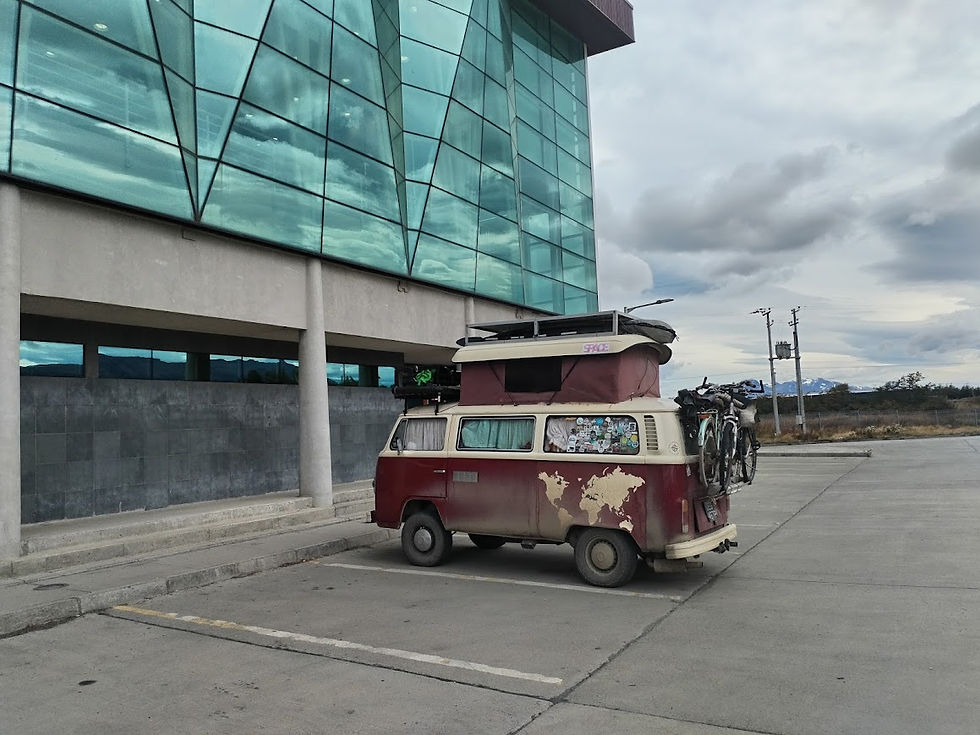
First, we headed to a supermarket where we bought enough food to last a week. Another important purchase was three large 7L bottles of water. In the supermarket car park, we emptied the water into our tank, dried the bottles out and then kept them ready for fuel. With those stowed away, we headed to the petrol station where we filled both the main tank and our spare jerry cans.
We now carried 55L of fuel in the main tank and another 40L in reserve. That should do it.
Feeling prepared for the next adventure, we continued north.


Comments