
San Pedro de Atacama
If the dizzying heights of Bolivia hadn’t been barren enough, crossing into Chile dropped us into the Atacama Desert — one of the driest places on Earth. Even though it hadn’t been long since we’d dipped in the warm pools up there, we decided to follow Louis and Kareen to a campsite for a proper hot shower. We had heard Chile was expensive and, as we started looking into campsite prices, it certainly seemed that way. We settled on the cheapest one with a hot shower, which would still set us back the best part of $20. A treat.
We agreed to meet there later and headed off to deal with our respective chores. We needed to stock up on groceries, not wanting to carry too much through the Chilean border, while our friends had paperwork to sort for their Chilean-plated car.
We continued our speedy downhill descent until the sun beat down with a ferocity that told us we were no longer very high up at all. Officially, it seemed petty crime was potentially a thing in this small desert town, but the only option for secure parking was shut. It was a very hot day, so we needed to be quick anyway for the sake of the cats. Our first port of call was to find an ATM, but as we went to roll up the window, it broke. I stayed with the van to see if I could fix it while Lee went for cash. Neither of us did particularly well.
It seemed the ATM in the pharmacy didn’t charge, but that was currently boarded up. This left him with two options: the first charged 8000 CLP and the second 5500 CLP. Bear in mind that the Chilean exchange rate approximately equates to dollars when divided by 1000. That’s a pretty hefty fee just to use an ATM, but there were no other options, so he reluctantly bit the bullet and withdrew some cash.
Back at the van, I had deducded that the window regulator bracket had snapped off the metal plate that holds the glass. We would need a new part, and there wasn’t much else I could do except liberally tape it shut with duct tape.
The little town of San Pedro de Atacama is a huge tourist destination. Despite being quite remote, it boasts a whole host of activities and is the last stop on the Chilean side before crossing into either Bolivia or Argentina. The small dirt streets are mainly too narrow for vehicles, and you can walk across the entire town in about fifteen minutes. The central streets are lined with dreadlocked people selling artisan jewellery in the spaces between tour agencies and bars.
Despite that, it has a certain charm to it — a nice relaxed vibe. We wandered around for a while until we found the biggest supermarket, where we were hit squarely by the price increase. Bolivia is one of the cheapest countries on the continent, while Chile is probably among the most expensive. It was unfortunate for us to draw such an immediate comparison, because we weren’t quite ready for it. With prices naturally higher, you can also add on a little more because you’re buying vegetables in the middle of the desert, in a tourist hotspot.
With our expensive shopping bought, Lee backed Ruby down the narrow street to collect everything. We decided we’d set off for the campsite and try to negotiate a price for two campers. The only reason we were considering it at all was if the river was dry — if there was water, we wouldn’t have needed to pay for camping. Of course though, once again we're in the desert so we weren't optimistic. It didn’t take long to cross town and reach the bridge over the river. It was exactly as we feared: nothing but a dry riverbed. If we wanted a shower, we’d have to pay for camping.
As it’s such a small town, there aren’t many camping options for vehicles, backpacking being the preferred style here. We headed for Casa del Sol, just around the corner — a hostel and campground primarily geared toward that crowd, but with a parking lot for campers too. At the desk, we asked if we could stay. The first question was how big our car was.
“Small,” we assured the lady behind the desk. “Just a combi.”
She got up and led us through a sea of tents, out a door at the back, and across the road into their parking lot. She showed us the toilets, showers, and kitchen. We would basically be staying in a car park, but at least it had reasonable facilities. We asked if they’d offer a discount for two campers, but she said this already was the discount. Reluctantly, we agreed and pulled into the small dirt lot. We were going to refill all our water and get our money’s worth. Perhaps even have two showers. We set about cleaning some of the dust off Ruby and were just about to start filling our water tank when it turned out the water had been shut off. Apparently this was a common occurrence here — rather irritating, considering it was the main thing we’d paid for.
It was a while before our friends arrived and camped beside us. We decided we’d go into town that night for a few drinks rather than sit in the parking lot. Lee naturally gravitated toward the bars offering craft beer, and our first stop was Cerveceria St. Peter. While I went for a fairly non-offensive lager, Kareen and Louis ended up with a very suspicious-looking mojito, which I think it’s safe to say they didn’t enjoy.
We moved on and ended up in ChelaCabur, one of those places where every inch of wall is covered in graffiti and stickers. We toyed with the idea of eating out, but the cost of the drinks alone was enough to put us off. We decided this was becoming an expensive venture — especially just for a burger — and headed back to the van to drink cheap beer and cook for ourselves.
At least by then the water was back on, and we could start filling everything up. I wasn’t risking it being turned off again before we left tomorrow. Lee made some killer burgers while I filled the tanks.
We had already decided we definitely wouldn’t be paying to stay here a second night, while our friends still wanted to. They had a few things to sort out and, while I had imagined we’d part ways at this point, we realised we both still wanted to visit the Magic Bus and the salt pools out in the desert.
With a brand-new visa, time was suddenly a luxury. We decided that while they got their paperwork in order, we would go and find a free spot for a few days. When they were ready, we could head out into the desert together. Then sadly, it really would be time to say goodbye. We had read a comment from another camper saying that if you stayed too long, they’d charge you again. So we were particularly annoyed when Aimee decided to bugger off the following morning. It’s not like we didn’t know where she was — hidden under the bonnet of what appeared to be someone’s project car. Her tracker worked brilliantly and led us right there. Unfortunately, there was absolutely no way we could get her out. We sat nervously twiddling our thumbs, ready to explain to reception that we really were planning to leave but… well, you see, it’s the cat…
Eventually Aimee broke cover and moved from the car into a nasty bush on the edge of the property. While it wasn’t much easier to get to her there, we could at least hack our way around the back and drag out a very bad bean. We dumped her unceremoniously in the back and sped out of the gate before someone could take any more of our money.
While we waited for Louis and Kareen, we decided to find some free camping near town. We headed out down the dry riverbed, looking for somewhere quiet off the side of the road. There was a little water in the river that we could have used if we were desperate, and we drove past a few spots previously highlighted by other campers. However, as we crossed over the river at the far end, we spotted a large gravel patch off to the side of the road and, just above it, a water channel. The water wasn’t the cleanest, but it would do for washing ourselves and our clothes. It was a very quiet road as well, so we decided to stay there while we waited for our friends.
We had planned on them being a couple of days, so we were in no rush to tackle the immediate maintenance Ruby needed. Louis and Kareen, however, had already left for Calama and messaged us the following morning to say they’d be stopping with us that night. We could then leave together for the salt pools out in the desert the next day.
We had driven the entire laguna route with our CV joint boots held together by duct tape. I had opted to wait until now to replace them, knowing that from this point on the roads were going to be cleaner. It’s a messy job, and one I hadn’t long done back in Peru. I set about cleaning all the grease and dirt from the joints before refitting and greasing the new boots. The air filter was also in dire need of cleaning and, after purchasing Bolivia’s suspect fuel, we decided to swap out the fuel filter too.
It was hard to summon the motivation to work on Ruby — all we really wanted to do was sit in the sun and relax. It had been a very busy seventeen days of non-stop moving, and now, with a shiny new three-month visa, we wanted to slow down. Our friends, though, were still on a deadline, so as much as we could happily have sat there doing nothing, we got the tools out and set to work so we could leave with them the next day.
They arrived towards the end of the day with another camper in tow — another set of travellers from South Africa and Canada, who they already knew, joining us for the night. We sat outside around a generous campfire built from the large amount of driftwood scattered around us. The meat eaters chewed away at Louis’s homemade biltong (a South African delicacy of seasoned dried meat), and we all enjoyed some cheap Chilean wine.
In the morning, the other travellers were soon on their way. They too had a deadline and were headed into Argentina. The rest of us got ready at a leisurely pace before heading off towards the salt pools. Located in the middle of the desert, these pools contain more salt than the Dead Sea. It was only around a 60km drive out to them, but it was going to be a horrible washboard road. We aired down our tyres and prepared ourselves for a three-hour drive.
The first section followed beautiful smooth tarmac as we headed out of San Pedro on the main road. Then we turned off and, for a few blissful minutes, the dirt road was hard-packed and completely smooth. For a second, I thought maybe they had graded it and it would all be like this — but it was not to be. Soon we hit the washboard and settled into a steady 20km/h crawl that felt like it might shake the van apart. After a couple of hours, we arrived at the pools.
All around us stretched nothing — bleak gravel mountains as far as the eye could see. Of course being Chile though, you had to pay. We pulled into the visitor centre and bought our tickets. It was about £10 per person, and there was a long list of rules to follow: no eating or drinking, no animals, only twenty minutes of swimming, and only in one allocated pool.
After Bolivia, I wasn’t particularly impressed.
We had already decided that some of the more famous sights on this side of the border we simply wouldn’t bother with. There were other lakes and geysers that, although beautiful, were very similar to their Bolivian counterparts — the main difference being an extortionate entrance fee. These salt lakes, however, seemed unique to Chile, so we made an exception.
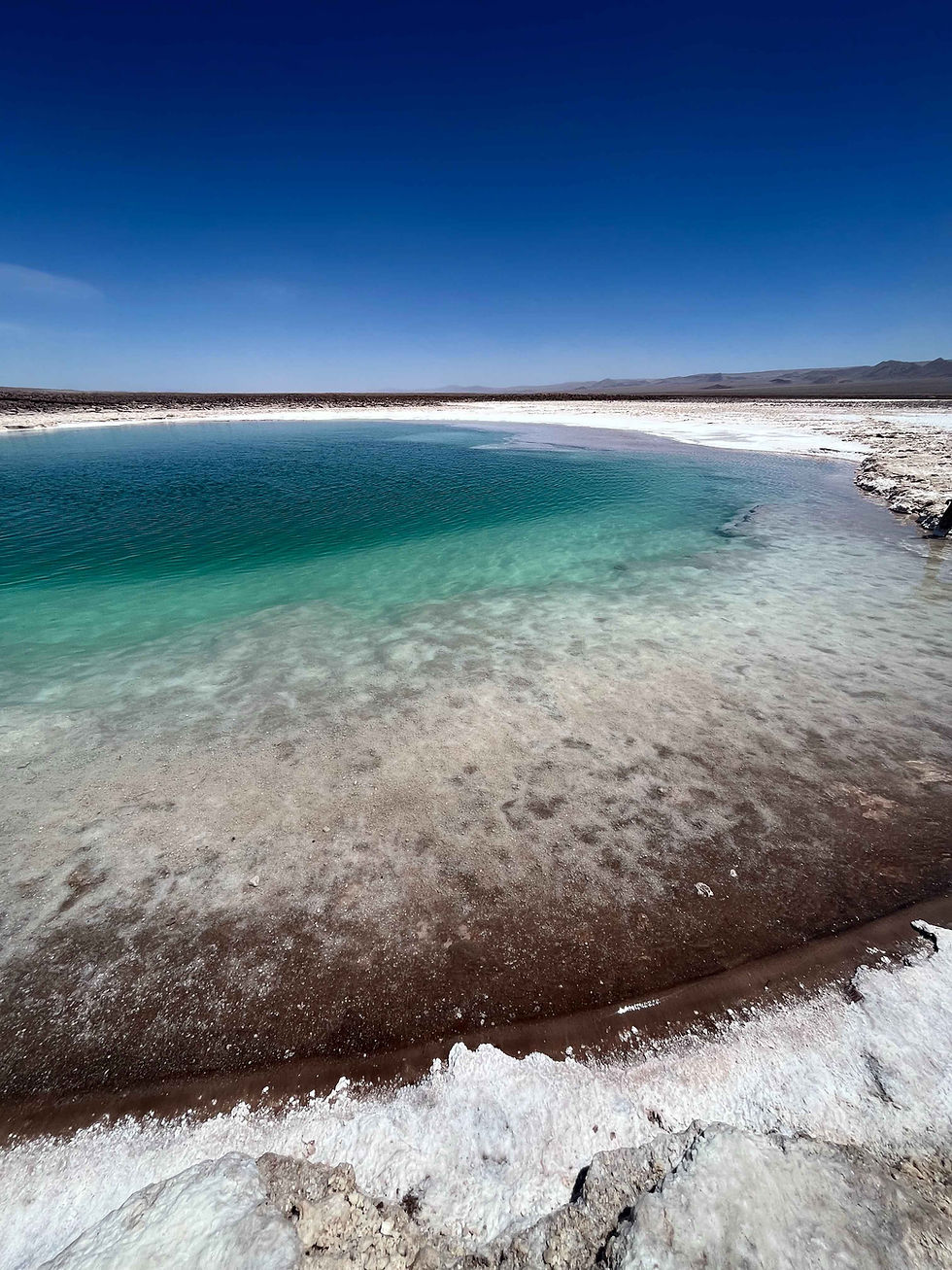
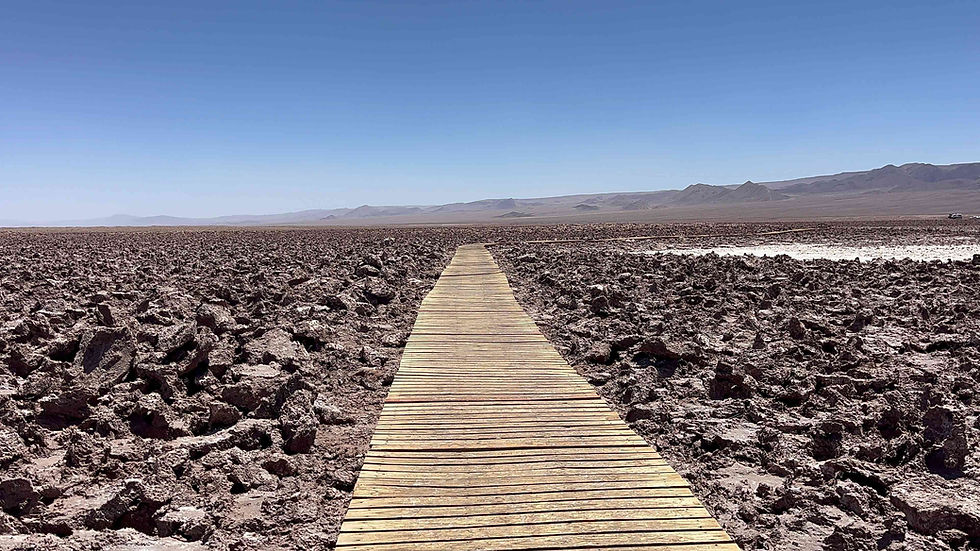
We parked up in the far car park and got changed. A long wooden walkway led from the parking area over the lunar-like terrain towards the first pool. None of it was particularly wheelchair-friendly for Louis, but that, of course, didn’t seem to bother him at all. He made it easily along the walkway and then bumped his way over the rocks and obstacles around the pools to make it in for a swim. Despite the twenty-minute warning, you wouldn’t have wanted to stay longer anyway. Even in the hot desert sun, the pool was pretty cold. The salt content was so high that it was almost impossible to swim normally — you were simply too buoyant. You could float sitting cross-legged in the water. It was actually very similar to swimming in the mud volcano in Colombia.
After a brisk float, we were back out warming up in the sun.

Kareen and I walked a little further down to look at some of the other pools. They were indeed beautiful and otherworldly, but also pretty small, so it didn’t take long to see everything.

Back at the cars, the salt covering us was so intense that our swimming clothes had gone hard, as though they were frozen. Our arms and legs were completely white. The most ridiculous thing was that they charged such a high entrance fee for such a short visit, while providing no showers at all. They had them there — a brand new shiny shower block — but without any water. I appreciate the difficulties of bringing water to the middle of the desert, but still, after bathing in salt like that, you really did need to wash it off.
Luckily, as campers, we had more options than those who had arrived by car. Lee and Kareen filled buckets of water from the toilet sinks and carried them back to the campers parked at the back. I found a piece of wire on the floor and used it to tie the exhaust back on, which we had nearly lost on the dirt road. Then we all used our USB shower to rinse off the worst of the salt. I was definitely going to need some serious moisturiser later, but for now, at least, we could get back in the cars without feeling utterly horrible.
Once again, we headed for the horrid washboard road.
We planned to spend the night at the Magic Bus. If you’re familiar with Into the Wild, you may already get the reference. While the Canadian version is somewhat more extreme, the Chilean version is easily accessible by car and a popular destination for night photography and stargazing. Unlike the salt pools, entry here is free and camping is permitted.

Before reaching the end of the washboard road, we turned right and headed for the mountains. The dirt track wound steadily around the base of the foothills as we drove around the back of Valle de la Luna. Once again, entry to the actual valley is expensive — but here we accessed the back of it for free. It really did feel like driving on the moon.

After driving around the site of the Magic Bus for a while, trying to find somewhere level and sheltered from the desert wind, we opted to tuck ourselves away around the back, in the midst of the old salt mine. All around us, salt rocks cracked in the afternoon sun, reminding me that it was probably very important we washed the car once we left here.

Louis and Kareen tried to park first, but promptly got themselves stuck. Eventually Ruby came to the rescue and towed them out, and we parked at an angle to best block the wind.
A little later we were joined by another camper for the night and got a brief lesson in night photography. The guy had captured some awesome shots of the van, and I tried my best with our little-used SLR camera. He explained the settings and the basics, but after a while it became clear that the camera had a fault and was proving difficult to use. Something for us to fix another day. For now, night photography would be left to my phone, which I don't think did too badly.

The following morning, the other vans packed up and headed off. Louis and Kareen were about to hightail it to Ushuaia before returning to Santiago to sell their camper. Since we were travelling at a more leisurely pace, we reckoned we could meet up again in Santiago. So while they bombed off, we decided we’d enjoy one more beautifully quiet night at the bus. With a little more time on our hands, and no company that evening, we spent it playing around, trying to take arsty photos of Ruby and the bus.


Comments