
Pan de Azucar
One reason for our rapid descent down the coast was that we wanted to be able to spend a few peaceful nights on this beach. A morning stroll revealed an even more picturesque spot, so we dropped the roof down and moved over. Here we could easily walk down onto the beach and it was also unlikely that anyone else would join us here, unlike the other larger flattened area. It turned out that this wasn’t something we needed to worry about. Despite the fact that we spent the weekend there, we were alone. A couple of other cars parked up and down the coast briefly, but not one person came within speaking distance of us and it was perfect.
We enjoyed the perfect blue skies and bright sunshine with a view like no other.
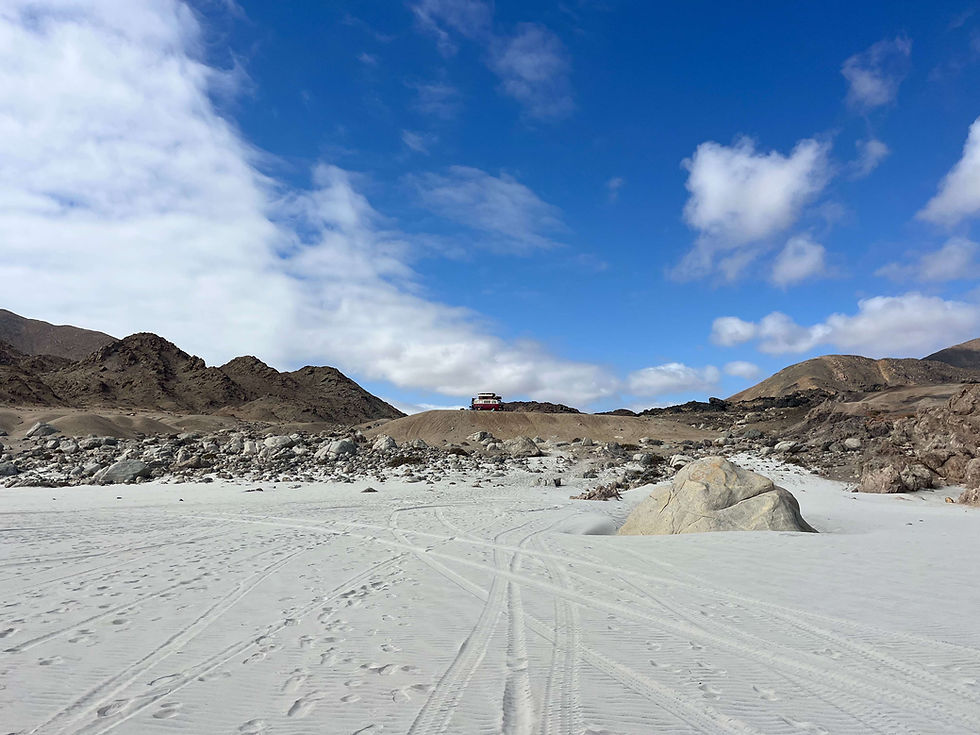
In the evening, we walked down the beach with the cats bounding alongside us. Lexi had the time of her life exploring the rocky coastline and with perfect signal we could easily find them whenever we wanted. There was little to worry about here anyway, no dogs and no cars.
We could have stayed longer. It was sad to wrench ourselves away from the spot, even after four nights. Time was ticking though and we still had a way to go, just under 1000km. To compensate for a lovely relaxed weekend, we now needed to push on every day in order to leave the country in just over a week. We picked another likely-looking beach spot and headed off.
First up, we stopped at the fuel station in Chañaral to refill our water. We still had nearly a full tank of fuel and I thought little of it as we set off. I hadn’t anticipated how barren this coastline really was though, and despite there being several towns marked, they were barely shanty towns and didn’t have any fuel stations. Normally, we carry spare fuel but in this expensive country it hadn’t seemed appealing to fill up the spare can. Therefore, when we arrived at the pretty Bahía Ricardo, we had no fuel. The next station was around a 40-minute drive away, which we wouldn’t make. That was a problem for the next day though and so we sat on the beach until a strong wind and the evening chill drove us inside.
The next day we faced up to the problem. We had enough to drive around 20 minutes to the next town, Carrizal Bajo. There was no fuel station marked here however, but we imagined we would be able to buy fuel somewhere off a local. We’d have to go ask around until we found someone. Our first stop was the local supermarket that had a rather unconvincing cardboard sign hanging outside saying ‘gas’. I was ushered to the front of the queue by a staring line of locals. This clearly wasn’t a touristy place. I asked if they had gas. The shopkeeper shook his head and waved dismissively behind him. At the beach, he told me. Where, he didn’t mention.
Still, it was encouraging that we could buy it somewhere. We headed for the beach. This time I asked a bunch of fishermen. They were a lot more helpful, pulling up a satellite map and showing me the building that sold fuel a little way along the seafront. We trundled off in this direction. The allocated building turned out to be a restaurant. A largely incomprehensible toothless man greeted us as we explained we were looking for fuel. He pointed us further down the road and told us it was near a palm tree. The search continued. At this point, we abandoned Ruby and walked down looking for fuel. A few hundred metres down, we saw a small red tanker on the ground and some likely-looking fuel containers. A friendly lady greeted us and told us she did indeed sell fuel. It was obviously very expensive, but we were glad to have found the treasure after the hunt.
Lee went to grab the car and we chatted for a little while. Finally, someone I could understand. Perhaps I was finally getting the hang of the Chilean accent, I thought. Until she told me she was Bolivian and then it all made sense. We put 10 litres of fuel in Ruby, enough to make sure we got to the next town, and then set off to refuel properly at the next large and more reasonably priced fuel station.
With the fuel situation sorted, we continued south. We decided we’d stay at the beach near the small village of Los Hornos. A few past visitors warned of a bit of rubbish, but we’d only be staying one night and weren’t too bothered. After several hours, we turned off the main road and headed down a lumpy dirt track to the marked GPS coordinates. What we hadn’t banked on was the ghetto that was now here. It seemed that the spot must have been marked before the existence of this place as the first of two points was now right in the middle of someone’s ‘house’. Black plastic tarpaulins flapped over makeshift canopies to protect the rows of tents that were erected underneath. Every now and again there was a car with a trailer attached. Stray dogs roamed between the tents and piles of rubbish. It seemed we had stumbled on some kind of refugee camp.
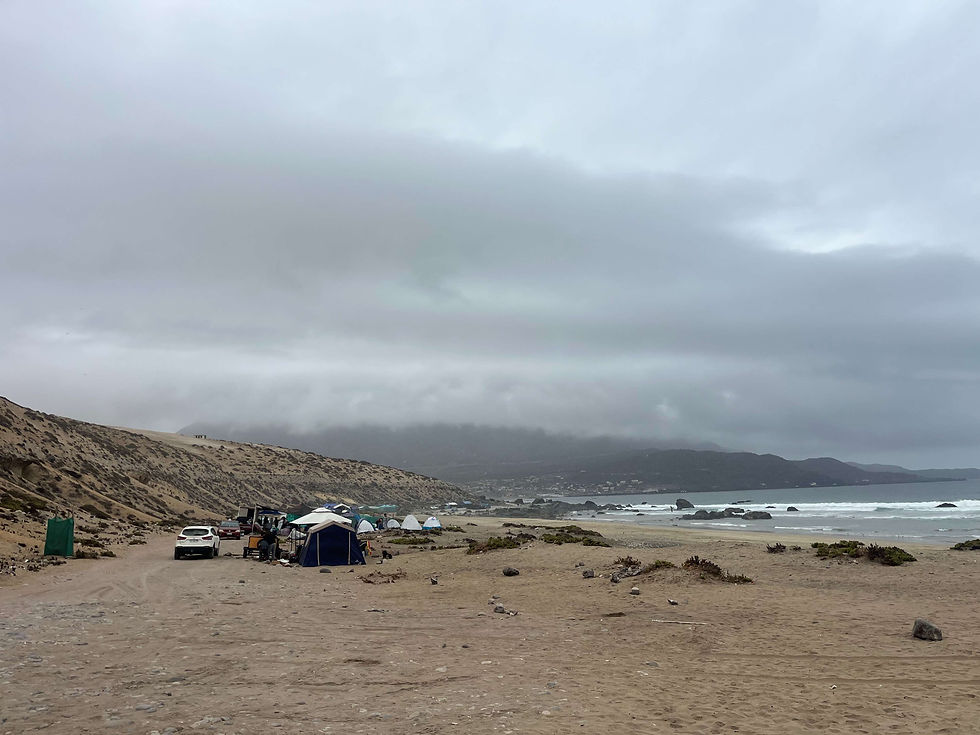
We headed down to the end of the beach until the road turned into soft sand and we could drive no further. Here a few families were enjoying the beach and despite not being completely comfortable parking next to the tent village, we decided we’d be fine for the night. We began to set up the camper when we noticed two small ginger kittens had appeared under Ruby. They must have only been around four weeks old and we put out our cats’ food and water for them, which they dived into headfirst. As we sorted out Ruby, we kept an eye out for the mum but she never appeared. We figured that these two must have been dumped here, and recently too as I doubted they could survive long at this age alone. We decided we’d take them with us to an animal sanctuary in Santiago if they were still there in the morning, but luckily the appeal of cute kittens was enough for a nearby family on the beach to come over. They asked if they were ours and then took them away when they left.
The cars began filtering away at the end of the afternoon. The couple parked near us gave us two fish from his impressively full bucket before they too left. The people of the shanty town kept themselves to themselves and on the whole it was a perfectly quiet night. In the morning, we sat with our coffee and watched as one of the nearest ‘houses’ packed up. They cleared away their tarpaulins, tents, tables and chairs. Slowly everything was loaded into a small trailer on the back of the nearest car. I wondered where they were going. Had they found a job, or contacted family? Perhaps they had found a proper house to live in. We assumed they were from Venezuela, as it was common to hear about Venezuelan refugees. As they drove off, hundreds remained.
It was time for us to get moving as well and so we also continued on our way that morning. We planned to stop at Playa La Cebada; this was supposedly one of the final points where it was possible to access the coast. Beyond this, the wealth of the nearby capital had bought up the coastline and filled it with private ranchos, making it inaccessible to the public.
With the help of some satellite images to navigate the myriad of dirt tracks that ran down the valley, we found a quiet spot on a rocky beach. Its jagged coastline and crashing waves reminded me of holidays in Devon back home. The temperature too had dropped significantly. We stayed in our jumpers and made hot chocolate. The wind rocked Ruby and covered her in salt spray. Next to us, wild ponies picked their way through the stilted seaside plantation. All of a sudden it felt like a completely different country.
Unfortunately for us, the wind did not drop at night and we got little sleep as we were buffeted around. The clue was probably the towering turbines of the wind farm on the cliffs just above; windy was clearly normal here. Still, it was only for one night. Another four-hour drive would land us in the capital where we would spend our final days in Chile before crossing the nearest border into the long-awaited Argentina.


Comments