
Casa del Freddy
The following morning, it was Ruby’s time to shine. The last place my parents wanted to visit was Colca Canyon, just a couple of hours’ drive from Arequipa, so it made sense to end up back here before their flight. That meant retracing our steps across the altiplano, past the turn-off to the ghost village of Sumbay, and over the highest road we had driven so far at nearly 4,900m. Unfortunately for Ruby, she’d be tackling her highest-ever drive with two extra people and a whole load of extra luggage, as there was no direct bus service from Puno.
We set off early from Puno, having got our deposit back from Antonio. The plan was simple: take it slow, take it steady, and try not to break her.
We loaded everything up—it was a squeeze—and climbed back into the mountains. The engine ran warm but without issue as we chugged along. We passed the turn-off to the ghost town before needing to stop and let things cool.
This was the section where the altitude really kicked in, and I wasn’t surprised Ruby needed a breather. Even with the cold air, the extra weight was clearly pushing her hard. She cooled quickly though, and we continued on towards Mirador de los Volcanes, the highest point on the pass.

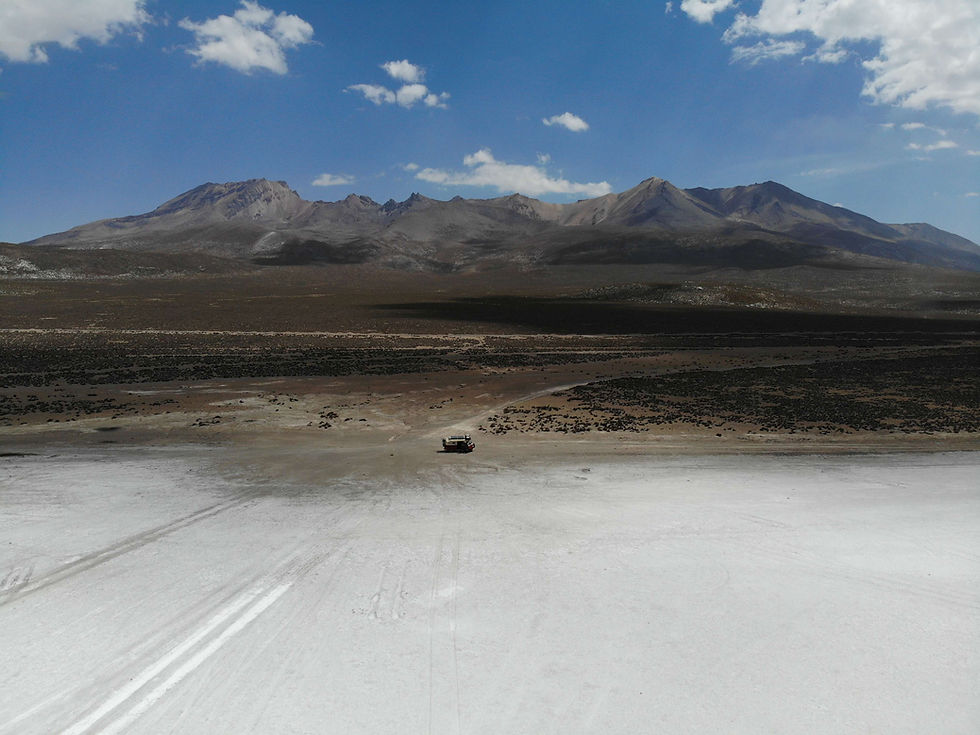
As we climbed, the landscape became even more desolate. At the top, we pulled into the viewpoint car park and stepped out into the thin air.
It was a stark, beautiful view: five volcanoes lined up on the horizon in a vast, empty landscape. We didn’t stay long—it was freezing.
I wanted a photo to mark Ruby’s highest-ever climb, but my mum wasn’t keen on getting out again in the cold, so you’ll just have to squint to see her sitting inside.

With the hardest part behind us, it was now a 1,500m descent to our accommodation near the village of Yanque. The road was good but steep and winding, as expected.
We had almost made it down when I started to lose the brakes and pulled over sharply on the roadside. Once you feel them go, you usually only get one or two more presses before they fade completely. It’s an unnerving sensation—especially on a steep descent where you really need them.
There’s nothing quite like slowly picking up speed on a downhill road with your foot already flat to the floor.
I let them cool for half an hour, then tested them carefully. They were back. With only a couple of hairpins left, we used heavy engine braking and eased our way safely down into Chivay.
The final place we were staying was Casa del Freddy. Freddy had been very responsive on WhatsApp, and slightly concerned that his small house might not meet expectations after being questioned about water supply. There was no washing machine here. In fact, there was no running water or proper electricity either. It was a simple stone-built house just outside the national park, with incredible views down into the canyon. The water system was containers, a garrafon for drinking water and then a big water butt in the bathroom for flushing the toilet. You could wash up using the little stream that ran through the property right by the back door and the tiny outside lean-to kitchen. All of the electricity ran from a single battery upstairs in the bedroom, charged by solar during the day. For the first time in a while, we would be sleeping in Ruby outside, as there was only one bedroom. The living space, however, was large enough for us all to eat together.
After a few days confined in Puno, the cats were desperate for freedom. We let them stretch their legs carefully, keeping an eye on the nearby road.
Freddy spoke good English and showed us around. The house was simple but thoughtfully built: a two-storey space with a kitchen lean-to outside, a living area downstairs, and a bedroom above. Water came from a stream or bucket, lighting was rechargeable, and the bathroom was basic but functional. It was modest, but full of care. My parents liked it immediately, especially after the previous places. In fact, they liked it so much they extended their stay by two nights.

For the first time, everything felt like a bonus rather than a compromise. It also meant the rest of our time together would be spent looking out over these mountains.
That night we returned to sleeping in Ruby for the first time in over a week. We tested our new thick fleece blanket, which was an absolute game changer at altitude compared to our thin duvet.
The following day was a slow one. I decided it was time to look at the Wallas heater. I’d been avoiding it for weeks, not wanting to confirm the worst. It didn’t take long to swap the main circuit board. Then came the moment of truth. I pressed the button. Instead of the usual failure sequence, the fans kicked in. The unit began its startup cycle. Ten minutes later I was doing a small victory dance outside the van. For the first time in six weeks, we had heating and cooking again.
Now we were ready for Bolivia—but first, there was still a canyon to explore.
Many of the hikes here are multi-day treks deep into the canyon, but we settled for a shorter route to the ruins and waterfall at Uyo Uyo, accessible directly from the house.
That plan lasted until we couldn’t lock the door.
After some failed attempts, we called Freddy, who arrived within 15 minutes on his bike, complete with a small trailer and a bottle of drinking water. He fixed the lock quickly and showed us how to do it properly for next time.
Then we set off down into the valley.
We passed through the village of Yanque and onto a narrow dirt road, crossing an old bridge with sweeping views of the canyon. Freddy had told us to look out for the grain storage niches carved into the cliff face—often mistaken for tombs as we crossed the bridge.
From there, the path climbed steadily to the visitor centre. Strangely, no one appeared to collect an entrance fee, so we continued on.
The climb grew steeper, with regular breaks to take in the views: terraced fields, scattered workers, and the vast canyon dropping away behind us.

At the fork, we chose to descend through the ruins first, planning a circular route back.
Much of the signage was faded or only in Spanish, but it became clear this was once a village destroyed during the Spanish conquest. Many buildings had been burned, and little remains today beyond stone foundations and walls. Despite that history, it was peaceful now. Eucalyptus trees swayed in a light breeze, cows grazed nearby, and birds broke the silence.
We continued down a different route, rejoining the main road and crossing the valley again via a lower bridge. We passed the Colca Lodge, then crossed another smaller bridge near the thermal pools before climbing back up into Yanque.
The final stretch back to the house felt longer than expected, but we were glad to return and spend the rest of the evening resting.

Comments