
Arequipa
It was the morning of the 19th of September, and it was the morning my parents would land here in Arequipa. They had flown into the capital, Lima, the previous day, and their connecting flight would bring them here this morning. I couldn’t quite believe the day had finally arrived, their first trip to Latin America. We packed up and set off for the airport to pick them up.
It was only a short drive, and soon we were parked directly outside the doors. It’s not one of those ridiculous airports where you have to pay £10 to park half an hour away, and we popped inside to see if the flight had landed. Despite not wanting to be late, it turns out that we already were. By the time we’d got to the right part of the airport and Lee was in a queue for an empanada, I spotted my mum. They had seen us come in and chased us through the airport while we’d gone looking for them. It was surreal to see them both after a year, and I can only imagine what it must have been like for Lee after four years. With both empanadas and parents successfully collected, we went to load everything into Ruby.

We had obviously jumped at the chance to have anything and everything brought out to us, and so both my parents had rather a lot of luggage. Aimee was booted out of her favourite driving spot while my mum and dad perched on our rock’n’roll bed. There are no seatbelts in the back, but there was so much luggage I doubt they could have moved anywhere anyway. We headed slowly out of the airport, with me sitting on top of the toilet and bags shoved everywhere. It was about an hour’s drive up and out of the city to the house they had rented on the outskirts. Lee negotiated the bad drivers, bad roads, and hot driving temperatures that caused us to pull over a few times as we climbed steeply out of the city into the foothills of the mountains behind.
My parents had chosen a house a short way off the main road, down a dirt track. Eventually, a rather hot Ruby pulled up outside the gates to be greeted by the owner and his wife, who were still finishing up the cleaning. There was a nice garden space here where we could park, and the cats would have somewhere to explore as well. While we could have stayed outside in the van, it was a three-bedroom house and so we had opted to sleep inside and enjoy a proper bed for once.
Once the cleaning was done, the owner showed us around, not that there was too much to show. He apparently lived in the city, but another guy who was also here named Vincento would be around if we needed anything. For the meantime, we started moving some stuff inside and getting set up.
We hadn’t really had the space to go food shopping in the city with all the people and all the luggage, so while the boys stayed at the house, Mum and I went back to do some serious shopping. The city is a fair drive away, the larger supermarkets being on the other side, and it took us an hour to get there through the typical bad drivers and busy streets. We also didn’t fit in the supermarket car park, and so we had to leave Ruby on a side street while we went inside. My first stop was a pharmacy, as throughout our whole time in Bolivia I hadn’t been able to find some of the pills I usually took. Here in Peru, it was far easier — just walk into the nearest pharmacy. With that sorted in a matter of moments, we headed into Tottus to do a big shop.
As the camper wasn’t close, once we had paid for everything I left Mum standing on the pavement surrounded by shopping while I went to get the van and loop back around the one-way system. This was pretty chaotic, as was the complete lack of anywhere to actually pull over. I dumped Ruby in the middle of a zebra crossing, boxing in the taxi rank. It was a very Latin American thing to do, but while they honked in indignation, I know they would have done exactly the same thing to us. With the shopping speedily loaded, we set off back across the city. We stopped at the only free cashpoint that Peru has for our foreign cards, before once again tackling the hill back to the house. She was a little less loaded this time around, but I still had to pull over to give the engine a break, especially without access to Lee’s phone to see an accurate engine temperature reading.
Now we had everything we needed for a few days, we spent the evening settling into the house and opening up the entire suitcase of things we’d been brought from England. Christmas had come early!
The next day my parents were understandably tired, and so they spent the day relaxing and enjoying the sun. We decided to look at the van suspension now we were somewhere a bit more suitable, and it didn’t take long for us to see that something didn’t seem right with the front torsion bars. One side dropped as soon as the hub was disconnected and seemed very loose. Without totally stripping it, it was hard to say, but it seemed like some of the front leaves had snapped. We messaged a few garages to see if we could find some spares, not wanting to disassemble it further than we already had. We decided we’d leave it for a day and see what came back to us before doing anything else.
In the meantime, my dad was discovering sandflies for the first time, and my mum had already given up on relaxing and honed in on the washing machine. While I soldered in our new OBD gauge for monitoring the engine temperature, Lee tried to figure out the water system and washing machine. Vincento showed us where the machine was located down the side of the building, and then it was a case of trying to persuade it to wash.
Apparently, the property’s water supply came from a tank above it on the hill, which filled up every night. We are quite used to limited water, and also not having hot water. Most places here don’t have hot taps at all, and we don’t have one in our camper, so this was pretty normal for us. It was a bit of a shock to my parents, and they were even less impressed when we appeared to totally run out of water. Vincento tracked the problem down to a leaking toilet and manually filled the tank again for us after a while. These kinds of things are commonplace in Latin America — not so much in the UK.
The next day we had possibly located a VW garage, as well as some replacement bars in the city, which came as something of a pleasant surprise. It was not something we wanted to spend our limited time with family doing though, so we got everything back together. Ruby was still perfectly drivable, just a bit low and wonky. I changed out our broken CV boot that had needed doing for a while, and we were now ready to drive again, just in time for our plans the next day.
For the remainder of the day, we walked down the valley from the house. The owner had told us that there were cave paintings down there. We didn’t really have any directions, and we hoped they’d be kind of obvious. We walked down the dirt track for a while, but while it was a pleasant enough amble, we didn’t find anything and headed back. We clearly needed better directions.
The following day, I had a surprise planned. My mum had spent her birthday flying out to see us, and so, as I had a rare opportunity to celebrate it with her, I booked us a cooking class in the city. The restaurant Chira Fusion had been very accommodating to all our dietary requirements, and I had booked us into a class at 10am.
While we would be enjoying recreating some classic Peruvian dishes, the boys would be sent off to do the supermarket shopping. We were a little early, having allowed plenty of time to negotiate the traffic of the city centre, but soon enough we were waved through to have a seat in the bar. Head chef Magaly showed us to a small table, pointed out the toilets, and went to finish getting the kitchen ready for our class.
We would be cooking two dishes each, as well as learning how to make a pisco sour to enjoy alongside our food. The first thing we prepared was causa rellena, a dish I’m familiar with as we had a rather fancy version of it back in Lima. It’s basically mashed potato that you put in a mould to create a sandwich filled with local prawns. It was the first time I’d ever prepared prawns, and I can’t say I enjoyed it particularly, but our finished dishes were looking good and we set them aside, ready to start the main course.
My mum was going to be making stuffed rocoto peppers, a large but spicy pepper that is traditionally stuffed here in Peru. I was going to make ceviche, and I wasn’t quite sure how I felt about that either, but I tried to keep an open mind. There were just the two of us in the kitchen with the head chef and one other. They took loads of photos for us, and were patient and helpful throughout. We were having a great time. I think it was the first time I’d ever flambéed something too!
This concluded our two dishes, and we hung up our aprons and headed back into the bar to learn how to make Peru’s traditional cocktail, a pisco sour. We went for a passionfruit version, and after a lot of shaking, that was ready too. We were invited to eat our food on the rooftop terrace, and we invited the boys along too, as we had created some rather generous plates and there was no way we’d be able to eat all of that just the two of us. Even with four people, it was a filling meal, and we enjoyed our food and cocktails in the sunshine, looking out over the city.
I think it was a pretty good success.
With the day still young, my parents wanted to go and visit the famous monastery of Santa Catalina. We drove Ruby around and parked her up in some secure, shaded parking for the cats. Lee headed off to a bar to watch the football, while my parents and I made our way to the monastery, just a couple of blocks from the parking.
A huge monastery right in the heart of the city, this place clearly receives plenty of tourists. It even has its own downloadable app. We paid for our tickets and followed a self-guided tour around the site using the app and the information boards.
The place is almost its own city. There were quarters for novices, and separate sections for different residents. As a nun devoted herself to God, the size of her dowry determined the size of her residence here. All had roof access, a kitchen, and a sizable bedroom. Some were practically luxurious, with multiple rooms and huge beds built under archways to protect against earthquakes.
There was an enormous kitchen, as well as a laundry area and several chapels. It took us several hours to walk around the whole site, including the viewpoint from the roof of the main church.
After our visit, we headed off to Nowhere Brewery to join Lee in the sun for a drink.
Back at the house, it was our turn to cook, and we went for something I’m pretty sure my parents had never tried: traditional Latin American patacones. We had been taught how to cook these back in Panama, and as we arrived back quite late, they seemed like the perfect quick, snacky meal — the kind you want after already having had a sizeable lunch.
With a few days still left in Arequipa, we decided to take a trip up to the Salinas, Peru’s own salt flats. Despite not being far in terms of distance, it was a tough mountain road that ascended 1,700m. It seemed Ruby was not a fan of the Bolivian fuel either, and doing a drive like this, especially with two extra people, caused our fuel tank to once again develop its strange pressure issue. We pulled over on the side of the road with the tank pressurised and spurting petrol violently out of the filler cap. It took around 45 minutes for the pressure to drop and for us to be able to restart the engine. My parents were getting to see the disadvantages of travelling in our van. At least we had a view to enjoy in the meantime.
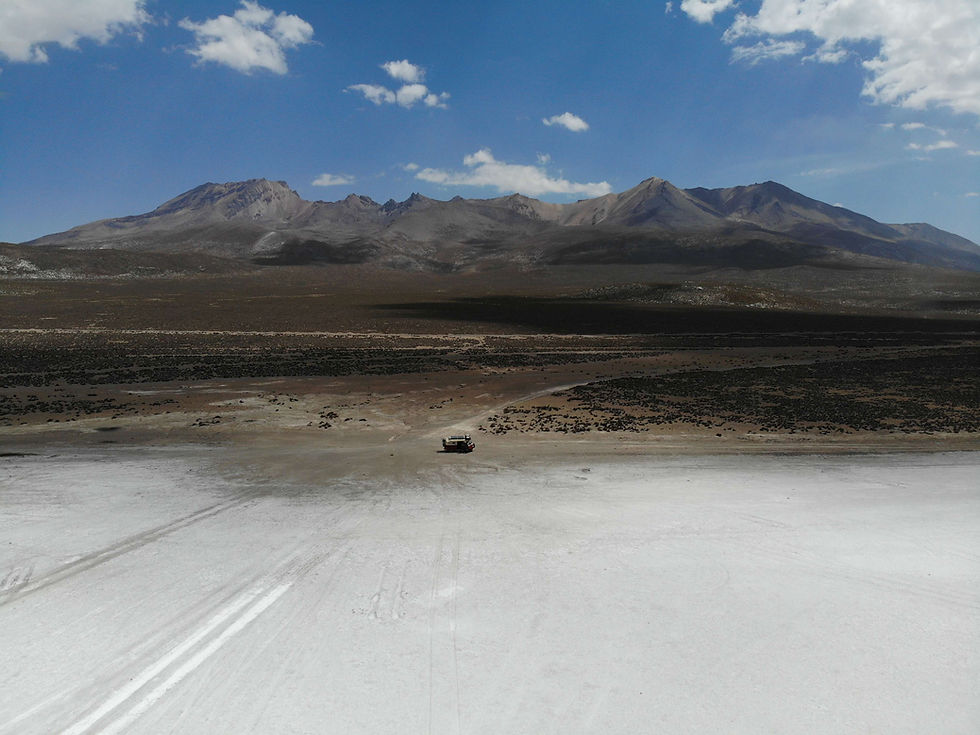
Still, she got us all up there, and we stopped at the salt flats to enjoy our lunch, watching vicuñas roam around us and dust devils spring up out of nowhere before disappearing just as quickly.
From here we continued on to some hot pools and a very small volcano. The volcano itself wasn’t particularly exciting, but you know if you’re there you may as well stop. Lee and I went for a dip in the warm, eggy water, which neither my mum nor dad were particularly enthusiastic about. I can’t say I blame them. It was pleasant enough, if a little sulphurous, until you came to get out, when a freezing wind whipped around us at this altitude of 4,500m. Even the short dash to the changing rooms was enough to chill me to the bone.
As the sun began to lower, we started our slow descent back to the house. Tomorrow would be our final day here before heading off to Puno.
We had yet to find the elusive cave paintings, and the owner Roberto came to show us where they were. We piled into his car and drove a short way up a different dirt road that ran along the top of the valley. He pulled over and attempted to scramble down the loose rocky slope to the bottom. Sharp bushes and a lack of anything to hold onto meant he soon abandoned that idea. It was clear from where he was trying to get to, though, that we had been in completely the wrong place.
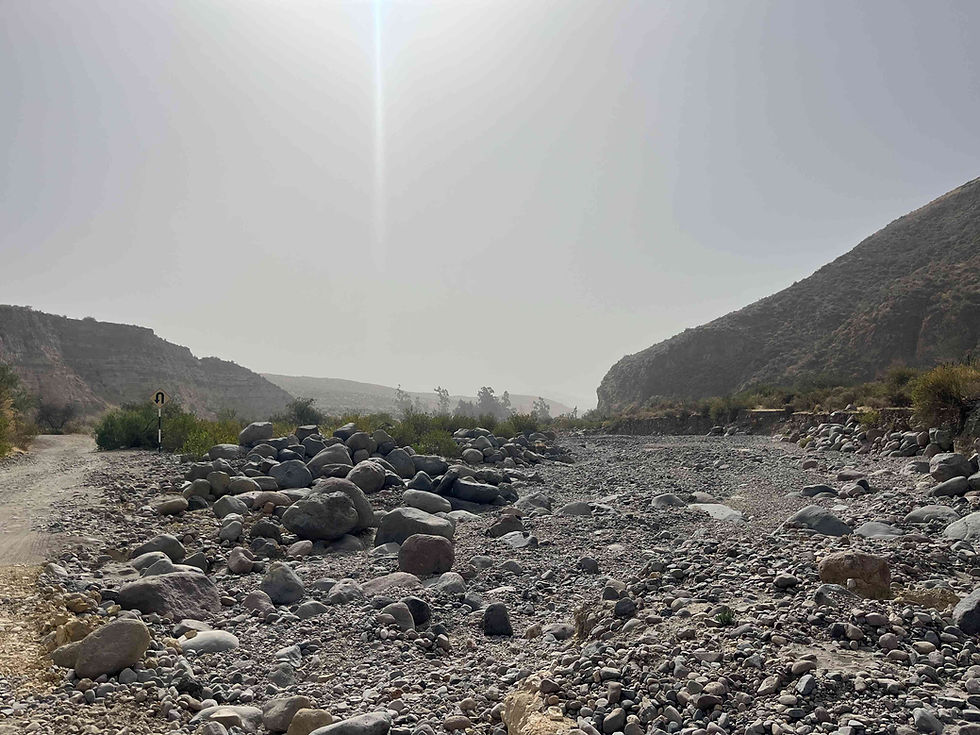
We drove back around and tackled the valley from the other side. Leaving the car at the end of the dirt track, we picked our way through scrub and down a dry riverbed. Roberto led the way, and at several points I genuinely wondered if he had any idea where he was going. He zigzagged down the riverbed, trampling through bushes in a haphazard manner, occasionally stopping and changing direction.
But he did know where he was going.
Suddenly he veered off up the hill and stopped outside a small overhang in the rock. There was no way we would have found this without him. We ducked low to enter, phones out as torches to illuminate the dim walls, and he showed us the paintings that told the story of the people who had lived here.
In red paint across the back of the cave, the story unfolded from left to right. It began with water, trees, and birds. Then people arrived, built houses, fished in the river, and hunted animals. Later, another group invaded their village, and a large fight followed. The paintings show someone being run through with a spear, and another figure bringing down a large rock.
The sequence ends with a handprint of an adult and a child, painted beneath a starry sky. I’m not sure who won the battle, but it was clear the victors remained here by the river. These paintings were more rudimentary than the ones we had seen in Sumbay, but they were just as old — and perhaps more powerful for the story they told. It was kind of special that Roberto and Vincento had taken the time to show us.
That day also happened to be the cuy festival in the small village above us. Roberto was very keen for us to come and try the local delicacy — cuy, or guinea pig. We had seen it all over Peru but never tried it. As Lee was probably the only one willing to risk it, the rest of us grabbed a bite back at the house first, then got back in Roberto’s car and headed up to the village. Vincento had gone ahead on his quad bike and was already at the roadside fighting off locals to secure us a parking space.
The festival was held in a large open field. Half was lined with food stalls, while the centre was filled with tables and chairs, all surrounded by someone in a giant guinea pig costume dancing through the crowd. My dad was, understandably, impressed.
We ordered a plate of cuy and some trout to try, and Roberto added a selection of local desserts called picarones — doughnuts served in a burnt sugar syrup. They were incredible, and I ate far more than I should have.
We perched on the edge of a table and slowly, over the course of an hour or so, managed to acquire proper seats. Roberto and my dad were getting on well. Lee wrestled with his greasy cuy, which stared resentfully up from the plate, its little legs splayed and teeth bared in a permanent scream. I turned my attention back to dessert and went with Mum to get ice cream. We picked up beers from a local stall and spent a few hours relaxing there.
When it was time to leave, Roberto kindly drove us back. He and Dad sat outside for a while chatting and drinking the local combination of Inca Kola and beer. Mum and I started organising the house. We had not only brought in a lot of things from Ruby, but we’d also accumulated more along the way. Tomorrow we would be leaving, and some serious organisation was needed.

Comments