
Antofagasta
Now that we were alone again, we went back to the slow plan. The following morning, we headed back to our free spot in San Pedro and spent a few days there. It would have been nice to spend a little more time enjoying the cute little town itself, but with the price of camping — and also of eating and drinking out — we decided not to. What we both fancied was some coast. We hadn’t been near the sea since we entered Peru, so we packed up our things and decided to go and spend some time relaxing on the beach.
Chile is not a wide country, driving across it is easily possible in an afternoon. We stopped off at the town of Calama to pick up a Dremel and some car filler. I decided that we should try to cover up the damage to Ruby’s panels before we hit the coast and rust could set in. Up here, the humidity was so low it was of little importance, but the humidity and salt at the coast would no doubt eat away at the metal fast. With this in mind, we didn’t drive all the way to the coast. We headed out of Calama, as it had a very poor reputation, and found a small spot in the middle of nowhere in the desert. There, we drove a little way off the main road and parked up for the night.
The next morning, I attacked our bodywork with the Dremel. I pulled off all the loose filler and ground the edges back to where it was still firmly attached to the metal. Even now, I couldn’t see any reason for the huge cracks that had appeared. The metal underneath looked to be in good condition. Then I slapped on the entire can of filler we had bought. It was a messy job and needed a lot more filler to finish properly, but at least for now the metal was protected. The other side we simply taped up, as it was more of a single crack. Down in Antofagasta, we could buy some more materials to finish the job properly.
We were still at a reasonable altitude here in the desert, and so that morning’s drive was an easy one as we slowly descended towards the coast. We arrived in the city late afternoon and made a beeline for the nearest large supermarket. Even though there weren’t any recent warnings regarding robbery there, we still weren’t very comfortable leaving Ruby in a large unattended car park opposite the shopping centre. Between shops, we checked on her from the huge windows above and made sure we were in and out relatively quickly.
It seemed that camping wasn’t really a thing in this town. One campsite was marked on the outskirts to the south. It was incredibly expensive and had very bad reviews, so we opted for the only available free option — some street parking behind a few large apartment buildings directly on the coast. Even though it was technically a street, the beach started right next to us, so the cats had space to run around safely away from traffic. We spent a pleasantly quiet night there, and now that we knew we had a base, we spent the next couple of days organising ourselves.
Back in Bolivia, we had bought a large monitor to replace our broken laptop screen and had been using it to edit videos. The problem was storing the thing, and already we had damaged it simply because there was nowhere sensible to keep such a large but delicate item. Then it officially met its death when I accidentally wired the connector backwards while trying to do something else. This meant the main laptop was totally out of commission, and we needed to find something else quickly.
The best option would be a small portable screen. It was the same size as the laptop, but less than a centimetre thick. We could store it in the bag along with the computer, making it far less likely to be damaged. Now we just needed to get our hands on one. They were available on Amazon and also on Mercado Libre, South America’s equivalent of eBay. In order to purchase something from these sites, we needed a local address, so we reached out to someone nearby.
After a bit of a delay, Luis got back to us. In the past, he had run a workshop in the city and had let overlanders stay there and repair their vehicles. It appeared that this wasn’t something he did anymore, but he was still happy to help travellers where possible. He agreed to meet us and said we could use his account and address to order what we needed.
We met him outside his house, where both he and a friend were waiting for us. We chatted briefly, then I sent him a list of the things we wanted to buy. He totalled everything up in the shopping cart and gave us the amount to pay. We should have been more organised and gone to a cash point first, because now we were forced to use the nearest one and pay an extortionate £8 fee just to withdraw money. The only cash point in Chile with free transactions wasn’t so readily available and was a half-hour drive away. Still, it would be good to have the laptop back up and running, so we bit the bullet and paid.
He told us he would be away for a week, so the things would be sent to his friend’s address instead. We exchanged numbers, and he said he would message us when everything had been delivered. This meant we needed to hang around the city for a few days, so we headed back to our safe street.
After parking there for only a few hours, a local family came out of their apartment to talk to us. They could see Ruby from their window and wanted to know about the trip and welcome us to the city. They told us we were welcome to come inside and use their shower or water if we wanted, and when we politely declined because we didn’t need anything, they brought us food they had cooked straight out to the van. We hadn’t been in Chile long, but already that friendly vibe was plain to see.
We decided to wait in the city until the computer screen arrived in two days. We collected it from Eduardo outside where he worked and told him we’d come back for the rest in a little while. We stocked up at the very nice — but not very cheap — market and headed north. We decided to camp in a little bay near Isla Santa Maria. Luis had recommended it as a peaceful spot. We’d stay there a few days and then, once the rest of our things arrived, we’d pop back into the city to collect them.
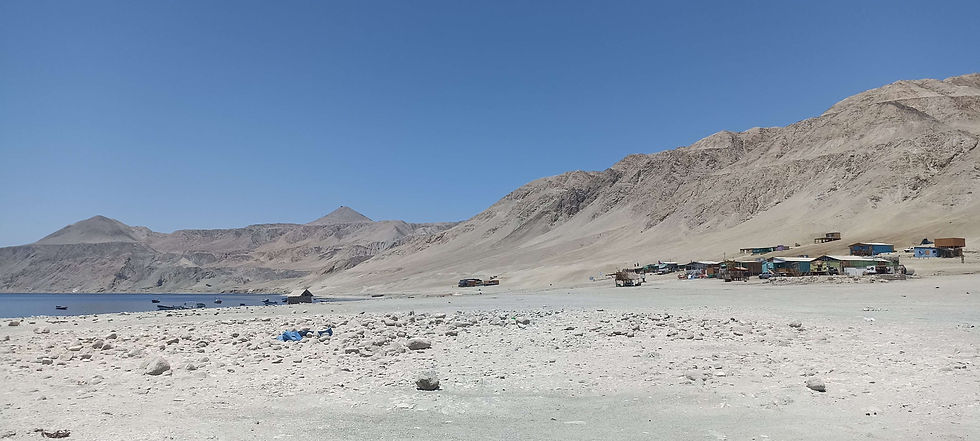
We drove out past the huge white sandy bay at La Portada and over the top of the hill. We dropped back down again to the sea on the other side, drove through the tiny shanty town of Caleta Errázuriz, and onto the beach.
It was indeed deserted.

Not the nicest beach — there was some rubbish, and the amount of seaweed in the bay gave the whole place a very fishy smell — but it would do for a few days.
The next morning, locals came crabbing. They dressed head to toe in wetsuits and snorkelled around the bay with their nets. A couple came to speak to Lee for a while and then, when they were done, waved him over with our coolbox and gave us sixteen live crabs.
We have never cooked or prepared crab before, so the rest of our day was spent following a YouTube video on how to prepare them. They were fiddly little things, and in the end we got a small bowl of meat from all sixteen combined. Despite being a small amount, it was beautifully sweet and couldn’t have been any fresher.
Our relaxing day of crab killing was soon brought to an end by the wind.
Even though we were surrounded on three sides by hills, the wind was ferocious and made for a noisy night. By the end of the following day, we had had enough of our things being blown across the beach and sand in our faces. We packed up and headed back to collect the remainder of our order from Eduardo.
In the end, this took quite a long time and some impressive detective work, as he sent us completely the wrong location. Eventually, we figured it out from the building in the photo he sent us and collected our things. As it was getting late, we stopped on our favourite street once again, where we were immediately brought sandwiches by the same lovely family.
Now that we had everything, we decided to try another beach. We stocked up for a week and left the city to the north once again. We passed through the small town of Mejillones, heading for the beach at Punta Choros. A surprisingly tough access road greeted us.
Leaving Mejillones at sea level, the road climbed quickly in a series of short, sharp bends through a narrow valley in the mountains. Once you reached the observatory at the top, you had climbed over 500 metres in a matter of minutes. From there, the peninsula was laid out before you, and you could see the crazy road continuing on until it appeared to fall from the cliff tops in the direction we were headed.
While it was in beautiful condition, sections were steep, and I wondered as we approached the cliff edge whether we’d get back out again. We crawled down in first gear, the engine screaming as we saved our brakes, and then none too soon, the road opened up onto a beach. The smell of burnt brakes lingered from other cars as we drove out towards the sea.
We parked up, set out the chairs, and sat in the lovely still afternoon sun.
This was better.

Our plan was to stop for a week. We wanted to catch up on blogs, videos, and some remaining jobs on Ruby. We were armed with a 3kg tin of body filler to tackle the side panels and still had a few odd jobs to keep on top of.

For the first time since we entered Chile, we truly relaxed. The nights here were quiet, even at weekends. The days were sunny and, on the whole, not too windy. We watched sea lions swimming close to shore and bought fish from the local fishermen. It was a great spot to be — so much so that, as we began to run low on supplies towards the end of the week, we decided we wanted to stay longer.
The plan had been to slow down in Chile and save money, something that was particularly important now that we had lost our income from our house back in England. With this in mind, we decided we would drive back to Mejillones and stock up for another week here.

Ruby made it out, blasting her way up the hill in first gear, local dogs nipping at the tyres, and then we were back on top. We could see down into the small town, surrounded on all sides by power plants and the straight nothingness that led back towards the city.
For the moment, everything seemed perfect.
But knowing us, that wouldn’t hold for long.


Comments