
We Only Came to See Birds
Updated: May 6
It was a hot night by the side of the laguna, but a quiet one, which felt long overdue. We awoke refreshed and set off for the tiny town of Loreto. While it may not have much in the way of houses, it is home to the blue-throated and critically endangered macaw, endemic to Bolivia, with a population of only around 300 birds. This little sleepy village was one of the only places in the world they could be seen. We thought we’d drive in for a tour and stay the night, hopefully. There was very little information about it. Someone had marked the spot as a tour and said they had just spoken to a local farmer. We had messaged in advance but hadn’t got a response, so headed off to see what we could find in person.
It was only a short drive, but enough to cover the camper in dust once again. Still, we were glad that it was dust rather than mud, at least. There was no way this route would be accessible to us in the rainy season. As we arrived in Loreto, we headed to the point marked on our map, supposedly his house. It was just a residential part of town, so we took a random guess at the house closest to the point and hoped the GPS was accurate. A lady came outside and asked us if we were okay. We told her we were looking for Chino and, by a stroke of good luck, she replied that she was Chino’s wife.
She invited us to park inside the garden in the shade, and while we did this, she set up two hammocks for us. She told us Chino was at the ranch, but that we could wait here, before bringing us homemade ice creams and sitting with us for a chat. Again, we were overwhelmed by the hospitality of complete strangers.
After a while, another lady turned up with a teenage boy. This was apparently one of the owners of the ranch and her son. She told us that we could drive out to the ranch and camp there. Her son would accompany us and show us the way. This sounded even better, so we packed up again and set off, with me driving and Raul in the front seat. We headed back out of town the way we had come for a few minutes, before turning off the main road and passing through a closed gate down an ever smaller and dirtier track. I hoped they had not overestimated Ruby’s capabilities in getting us there.
The short dirt track wound onwards, passing through the typical homemade livestock gates here, made from wooden branches wrapped in barbed wire. Every time we reached a gate, Raul hopped out to open it for me and shut it behind us. We passed through another ranch, and then the track became less clear. Now driving over knotted tree roots and grassy mounds, we went through the forest. Above us, the macaws soared. A raccoon darted across the tracks in front, and in the shallow marshy water to the left, we spotted a family of capybara. The beauty of this was that we were the only people.
After the forest, the track cut over rough grassland. Tough shrubs rose between two barely discernible tracks over the field. I hoped that too much shrubbery didn’t end up in the radiator and drove on slowly. Soon, we reached a small river crossing. The road had been built up out to a point and then stopped. I drove to the end and contemplated the route ahead. A short steep bank dropped into muddy waters, and on the other side the track continued out, waterlogged. Ruby is not the best in mud, but I hoped gravity was on our side and that a bit of speed would carry us through the worst of it. I just needed to make sure that our tyres hit the driest possible bit on the other side and avoided the deep muddy ruts, otherwise we would get very stuck and it would be very, very messy. I backed up a bit and took a run at it. Ruby slid through the worst of the mud, hit the other bank, and for a second the wheels spun as we slid across the mud. Then the tyres gripped and we came back onto solid ground a bit sideways, but not stuck at least. I hoped the road didn’t get any more interesting.

Still, we continued on. The ground remained solid, at least. Lee disappeared in a dust cloud in the back of the van. We reached another gate but apparently, for reasons that weren’t obvious to me, we couldn’t open it. We backed up and went around. The final stretch was a large open field, and at the back I saw the buildings of the ranch. We went inside the fenced compound and parked up. Raul hopped out and disappeared, his duty done.
We were soon greeted by Chino. Dressed in full cowboy leathers, he warmly shook our hands and waved us over to sit under some trees in the shade.

Stumps of old logs served as chairs, and around us other cowboys tied up their horses and removed their tack. We talked to Chino for a bit, and seemed to make some kind of vague plan about tomorrow. He said we could ride the horses, which made me pretty excited. For now, we were here pretty late, so he showed us around the ranch a bit before asking us if we wanted to join in counting the cattle.


It was now getting dark, and we sat in a big open-sided shed with a cattle crush in the middle. Cowboys in the yard herded the cows down towards the crush, and Chino stood on one end controlling the cows going in, while another cowboy manned the exit door. The two owners of the ranch were there too, as well as a guy with a notebook. This was clearly stocktake. As the cows were sorted one by one through the doors, the owner shouted out whether they were a cow, bull, or calf, and also who the owner was. From time to time, Chino joined us on the bench in between the waves of cows and plied us with a big pile of coca leaves and specific instructions on how to chew them. We hadn’t really banked on sitting there so long — they had around 1,500 cows — and so it was several hours before they finished.
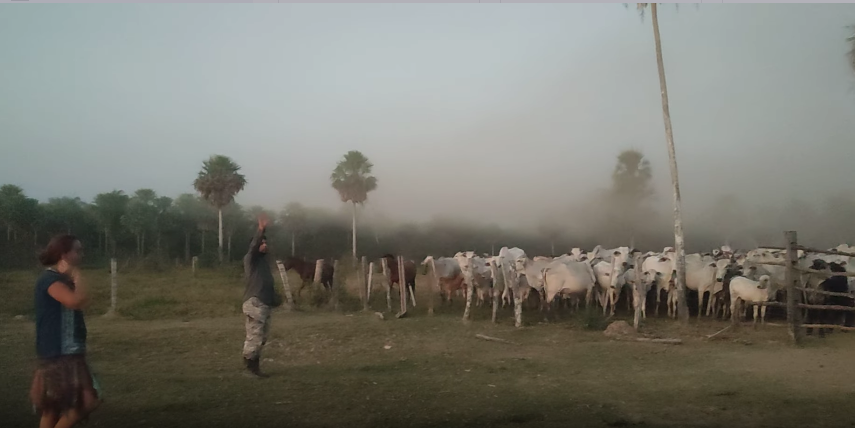
We excused ourselves back to the van to feed our cats and sort out the dusty mess again. Chino kindly brought us over a plate of food, and we thought the least we could do would be to go and be sociable.

We sat at a long table inside the biggest building. This was the kitchen, and clearly the women’s domain. There was no electricity here except for some rechargeable lights, and despite being dimly lit, with not much in the way of cooking equipment except a fire, the table had some generous food on it. The usual affair: huge lumps of cow, as was probably to be expected, as well as plantains, fried breads, and eggs. I explained I was sort of vegetarian and aimed for the rice and veg, while Lee’s plate was full of steak. The other cowboys ate with us, demolishing huge platefuls and washing it down with tea or coffee. We supplied our bottle of rum too, although it seemed a lot of them didn’t really drink.
Chino told us they had just killed a cow outside and that we could go and watch. I’m not sure I wanted to. We poked our heads around the door and saw that it was already dead, and three cowboys were already preparing it. The worst part was over, so we went and sat around a small fire with Chino, and watched them prep the meat. Chino told us that a cow was worth around $600, and so it was a shame when they realised they had killed one that was pregnant. Still, they matter-of-factly continued to prepare the carcass. Before long, the animal was in pieces, and all that remained was the vast stomach, full of grass. The intestines were emptied and hung up. The skin was trimmed and hung on a tree. Chino told us they would use the skin to make new whips. The local dogs got the scraps and leftovers that didn’t end up on the barbecue in front of us. Despite eating a hefty dinner, all the little pieces of meat that weren’t part of the massive joints were skewered, barbecued, and eaten right then and there.

While I may be vegetarian, I’m not against eating meat. This is definitely the way it should be done. One animal was killed quickly and used in its entirety. Nothing wasted. The skin, the bones, and obviously the meat. This was more a case of not being too squeamish; it was certainly an experience. I’ve never seen so many organs.
We sat with Chino for a while longer and into the early hours of the morning. He had no problem working his way through the bottle of rum, while continually snacking on cow.
While we were pretty sure we had plans in the morning, Chino came to tell us that they were going into town to sell the cow. So instead, we decided to give ourselves a tour. It was hot out here, and we set off in the baking midday heat to go for a wander through the surrounding land. The first section, we walked in a forest with large twisting tree trunks and parrots squawking at us from above.

Once we left the trees, the greenery became smaller and more dense. Now it was spiky shrubs we wandered between, as we followed the paths of the cows on their meandering route that headed in the direction of water. Even though the ground was dry and cracked, there was still a lot of green. We walked through a clearer section and headed back into the trees. Here the floor was littered with bright feathers, as well as what looked like the white fluffy cotton wool-like deposit from the silk floss trees that grew throughout this part of the forest.
We wandered on towards the river, and as we came near the edge of the forest, we heard the macaws. Following the harsh shouting to the trees that bordered the very edge, there we saw them in abundance. You almost wouldn’t know that there was water, as it was more of a wet field, but its presence was definitely a lifeline for the surrounding wildlife, and we saw many other species of birds here as well, including rheas.

After a good while watching them in the trees, I was satisfied that we had seen them. We retraced our steps and began to wander back to the ranch. On our way, much to my delight, we saw an armadillo. It was the first time I’d seen one alive, as it beetled away from us at speed through the scrub. I would have been satisfied with this alone, but there was more.
As we re-entered the trees nearer the ranch, we saw several coatis running for the trees ahead of us. Then, we heard the monkeys.
I had my birds; Lee had his monkeys.

Back at camp, we washed off the dust in the surprisingly cool pond at the back and settled down for an early night. Even though the cowboys were nowhere to be seen, one of the women came and called us in to dinner. It seemed like two solid meals a day was included here, regardless of who you were.

The following day, we weren’t really sure what was going on, as we hadn’t seen Chino for a while. We hung around for a bit until he showed up early afternoon. We arranged that he would come back the following morning for us at 10am. He was adamant he would come in case we had problems crossing the river. I reckoned we’d probably be alright, but it wouldn’t hurt to have another car there in case. We were happy to leave now; we had seen what we had come for. Despite the bright sun, the solar output here wasn’t very good. With the hot daytime temperatures, our batteries were starting to struggle. Knowing that we would be leaving the following day, we used our remaining battery power to cook a brownie for the women to thank them for all the food.
The following morning, we were packed and ready to go. There was no sign of Chino. We thought we’d just head off, and we went to tell one of the women in case people wondered what we were doing. She offered to phone Chino for us, and now we were told that someone else wanted to leave soon and we could follow them. It was turning into rather more of a big deal than it needed to be, and after waiting for this guy for a while, we decided we’d just go for it. We took the lady’s number in case it all went wrong and set off.

Despite it being uphill and muddy, the crossing seemed a little drier this time, and Ruby made it through easily. We made our way back out towards the town, having to stop periodically for the engine temperature. It seemed the radiator was full of mud or bits of bushes, as it ran incredibly hot. We decided we’d deal with it back at the house, and we pulled up outside once again. We’d pop in and say goodbye, we thought, before heading back out to Trinidad, most likely staying at the same laguna again that night. Naturally, that’s not what happened at all.


Comments