
The Laguna Route Pt.2
Our visa deadline meant that we could spend one more night out here in the national park before needing to cross into Chile the next day. We never like to push things to the last day when possible, especially out here where you never know how slowly you’ll be going. We decided that we would like to spend our final night at some hot springs. Nothing here was particularly far away, but at our steady rate of progress a handful of kilometres could take hours. Still, we were in no rush, and both of us stopped regularly to take photos or try flying the drone.
On one such occasion, Louis waved me over. He told me he had a present for me and then from the cab floor next to him, produced our aluminium side step. That explained the bang we had heard. Good job we had friends behind us to pick up the things that were falling off. They also returned our solar light a few hours later. At least while Ruby was losing a few auxiliaries, the cooling system was holding, and nothing else was going horribly wrong.
Before we headed to the hot springs, we wanted to visit the geysers. This is the highest point of the whole route at 4800m, and also one of the more ‘off-roady’ sections. The main route that connects everything is hard, dusty washboard. If you divert from this though, you find sand patches and much more rocky, uneven terrain. It’s less than a 10km diversion to loop off the main road and visit the geysers, but out there even 20km/h is impossible. We edged Ruby over rocks and around tracks worn so deep that the middle of the road scraped the underside of the chassis. We balanced ourselves on the outer edges and slowly made our way into the car park.
Once again a fierce wind buffeted us, and I added so many layers that I vaguely resembled a purple tartan version of the Michelin Man. While the lagoon had been otherworldly beautiful, this was even more alien. Toxic gases streamed from the ground and boiling pools of mud bubbled away. The earth was stained yellow from minerals seeping through the surface, and you had to watch you didn’t accidentally step into a boiling mud puddle masked by the mist blowing past. It was almost tempting to stand in the steam—it was warm, after all—but there was not enough air up here anyway, and walking into a mist already devoid of oxygen did not feel good. I emerged spluttering, slightly dizzy, and definitely smelling more of egg than I had previously.
It seemed others had camped here, but we wanted to drop to a (slightly) warmer altitude and we definitely wanted a wash after three days of dusty roads. Although I’d washed my hair only two days ago — practically unheard of — it was already stiff with dust. Spending some time in a hot spring sounded like a perfect way to round things off. We negotiated the track back out to the main route without issue, although Louis did offer me a shock absorber he’d found on the floor. I could confidently say this wasn’t ours for once. Clearly other cars had struggled out here too. We had now completed the hardest part of the route. From here it was all downhill—quite literally. The road had also improved slightly, and we were no longer dealing with the many parallel tracks that can easily lead you astray. Before long, we arrived at the hot spring.

While there was a paid option, we picked the free one. We could camp only a few metres from the edge of the pool. A simple concrete square, it was filled both by a plastic pipe feeding hot water from further up, and from springs bubbling up through the rocks beneath. At the back, the water overflowed and ran down into the lagoon behind. I wasted no time washing our floor mats in the warm water, and then we got into our swimming costumes, ready to wash days of dirt out of our hair.

We thought we’d been clever turning on the heating before getting in. We knew getting out would be unpleasant in the freezing wind, especially when wet, so a quick dash to the preheated van seemed like a good idea. I was particularly pleased we had done this when we discovered the pool was more warm spring than hot spring. We floated around for a while and then decided it wasn’t quite warm enough to stay in for long.

Lee got out and then told me the heating had turned off again, no doubt in the wind. Now by myself, in the dark, I found the warmest part of the pool where an underground rivulet fed in from under a rock and stayed there. With the last of the light went the last of the warmth. When it was time to get out I was already cold, and the outside air was on another level of freezing. It took a nice cup of tea to warm up after that one. Even though we were lower here, it somehow felt colder, and this time we managed to go to bed with the heating staying on all night despite the wind. The wind was so strong it woke us in the night, but at least we were warm.
The next morning I looked over to see Kareen trying to pry last night’s dirty dishes out of a frozen block of ice in their washing-up bowl. We had the same problem with my bikini, which was now frozen solid into a bucket of water. Luckily, we had a hot spring right there to defrost everything. Things were a little warmer in daylight, which was lucky, because I realised the floor mats I’d washed had blown into the bottom of the pool overnight. It wasn’t warm enough for a swim, so I remained in my woolly jumper with it rolled up to my armpits and my arms in the air, as I walked around the pool trying to pick them up from its bottom with my toes.
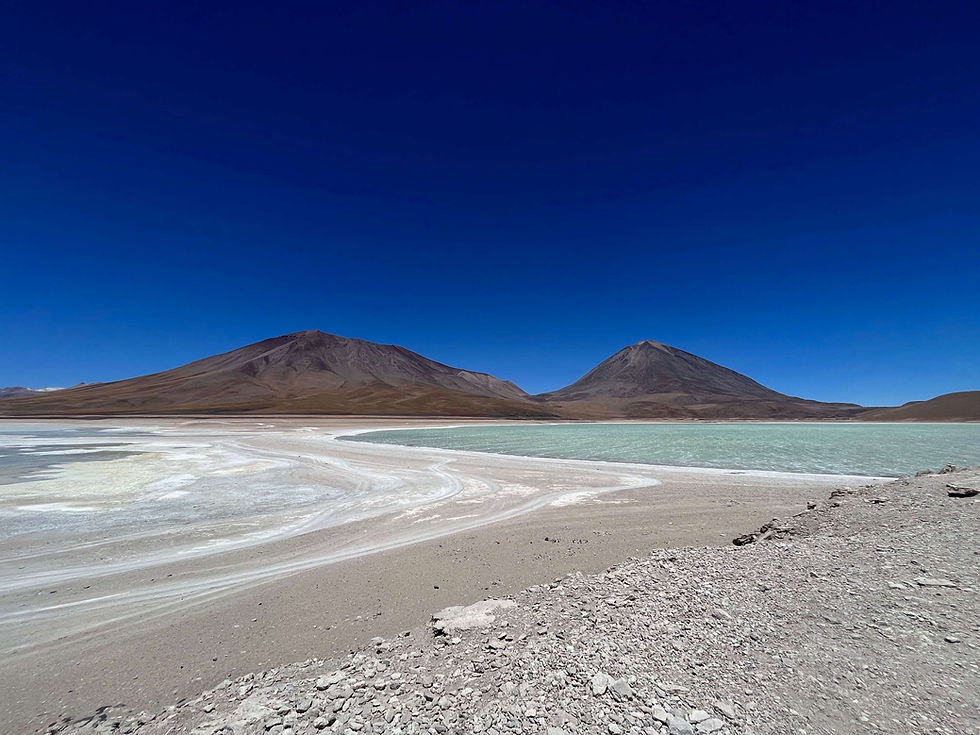
We were now dangerously close to the Chilean border with two more lagoons left to visit. They were only a short drive away, so we set off to complete our off-road journey by seeing Laguna Verde.

Once again, it was a slow and very lumpy drive with no clear route, but we made it, and all I have to show for it is this very quick photo I snapped. Once again it was very windy and very cold, and as pretty as it was, we decided the best course of action was to get into Chile.
This plan also suited Louis and Kareen, as it was the final of the South African rugby and they were keen to watch it. We all agreed we’d rather spend the night somewhere lower and warmer too. All that stood between us was the last of the dirt road and the border. It took a while to get back out—I seemed to pick a longer route than getting in—but soon we made it out in one piece. The border crossing here is split in two. On the Bolivian side you reach a barrier where you first show your national park ticket and then cross to the building opposite to cancel the vehicle documents. We also stopped at the small shop attached to the hostel to spend the last of our Bolivian currency.
The next stop is Bolivian immigration, a standalone building a little further down. As is our luck, we arrived on lunch break. We were told we’d have to wait an hour, but after about twenty minutes they processed us and the others waiting. Then we drove on. Unlike other borders where everything is metres apart, here it’s kilometres. We had officially left Bolivia, but still needed to reach the Chilean entry point.

Chile has a reputation as being the hardest border to cross due to strict rules about what you can bring in. You must sign a declaration each time, and if you are caught breaking it you can be fined several hundred dollars. With this in mind, we had actually done all our pet paperwork properly for the first time in this continent.
After a short drive, we arrived at the Chilean border building. It looked almost abandoned, yet also new and shiny. As we pulled up, the door opened and we were told there would be a short wait. A few minutes later, the shutter rolled up and we were waved forward. The reason it looks abandoned is that the whole facility is self-contained inside. Cars are driven in and locked inside while checked, with offices for immigration, imports, and vehicles around the edge. We hopped out and started the process. I was a little nervous, despite the fact that I knew all our documents were in order. Imagine being sent back to Uyuni for a piece of paper aftet all... Immigration was easy as usual. Then we handed over our pet paperwork and filled in a form. The vehicle documents were checked, including those for our bikes, and then it was time for inspection.

A young officer asked what we had. We showed him our sad vegetables as usual while he questioned us about other items: honey, plants, and fruit. Everything was going smoothly until he spotted my giant pinecones in the front. We’ve had them since America, and while Lee hates them, I’m quite attached. He said they might contain insects but eventually let us keep them and waved us on. Next border, I’ll hide them.
We got through fairly easily, and the doors opened on the other side to let us out. Kareen and Louis didn’t fare so well and were kept waiting for what felt like ages to be officially searched. They probably wouldn’t have cared normally, but the rugby was about to start. Eventually they surrendered their honey and were released. We drove quickly down to a spot we had found for the night. It was lower and far enough from the road that the cats would be safe.
It was about twenty minutes away and we drove along a beautiful tarmac road that felt almost too fast as it descended from the altiplano. We pulled off and in record time the laptop was out, the table set, and everyone had a cold beer. It suddenly dawned on me that we were in country number thirteen as we settled down to watch South Africa bring home the trophy, with plenty of swearing and nail biting from our friends, and Kareen finishing with a victory lap around the campers with the South African flag as a cape.
Despite the incredible beauty of the route, it was nice to be in a more temperate environment. Once again we could sit outside, chat, and enjoy a fire. We created this rather delightful piece of art to commemorate the occasion and sat there in the foothills of the San Pedro volcano, safe in the knowledge that we had all made it through in one piece.


Comments