
Ruta 40’s Hidden Oasis: Cafayate - Cachi
In this part of Argentina, a popular place to go for a night out is a peña. These are essentially the local equivalent of what we would call pubs back home: they often serve cheap set menus and almost always feature some form of live music or performance. Lee had picked out one in Cafayate that had stellar reviews, and we had planned to head there that evening. Unfortunately, the planning hadn't extended to checking their opening hours, and it wasn’t until we parked up on an unassuming side road on the outskirts of town and got ready to leave that he informed me it was actually closed.
Undeterred, we set off to find an alternative. There are, in fact, dozens of options. We walked down to the main plaza to see where looked lively. The most exciting event happening at that moment, however, was not culinary, but religious: the local church bells were in full swing. The church features twin bell towers, and as seems to be the custom here, the bells were being rung manually by operators standing right inside the towers. Instead of using a traditional belfry pulley system, the bell-ringers held the clapper directly, slapping it against the bronze rim by hand. This allowed them to produce a much wider range of sounds — dampening the chime instantly, tapping out rapid rhythms, and varying the volume. What particularly impressed me was that the teams in both towers were ringing their respective bells in flawless synchronization — no mean feat! We later learned that the bells were welcoming home the local pilgrims who were returning from their gruelling 400km round-trip trek to Salta.

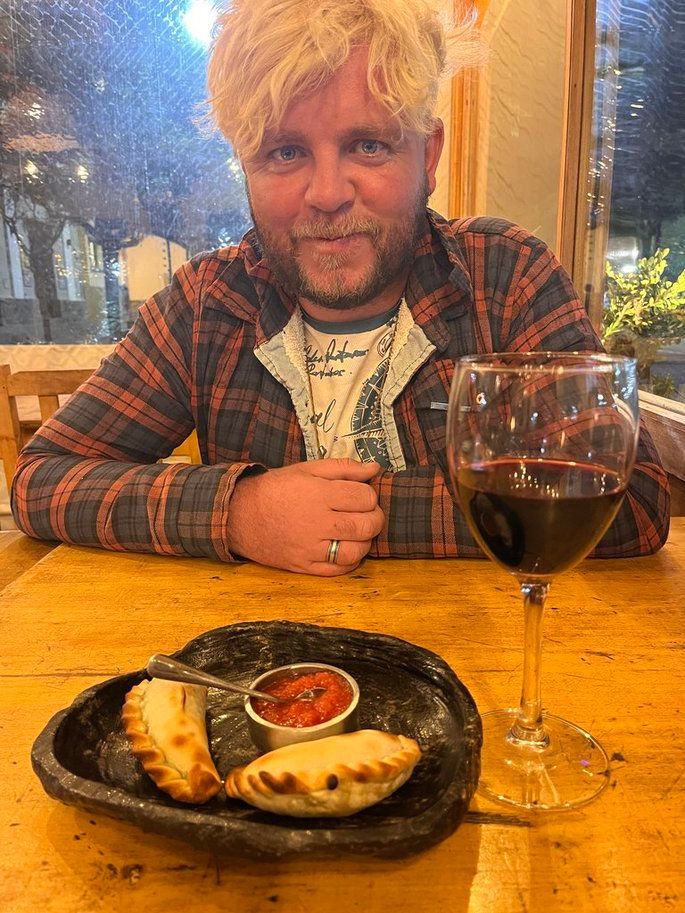
As we completed a circuit of the square, we were handed flyer after flyer from various peñas promoting their evening specials. We decided on a venue just off the square that had great reviews, so after checking it out, we booked a table for later and headed back to the plaza for a drink. It was only around 8:00 pm, so the nightlife was barely getting started. With our table secured, we settled down at a plaza restaurant to take advantage of a 2-for-1 deal on glasses of wine, ordering a couple of empanadas to tide us over.
When the live entertainment was about to begin at our reserved spot, we returned to our table. The venue was now about half-full, with a band setting up on stage. Looking through the menu, however, we realised that none of the food options particularly appealed to us, and the prices were higher than expected. Their main promotion was an all-you-can-eat pizza deal, but we felt we’d eaten more than enough pizza recently. We ordered a carafe of wine and pondered our stack of promotional flyers while the band played.
In the end, we opted for total authenticity. Even though it was approaching 10:00 pm, most locals were only mid-dinner. We returned to a restaurant on the plaza advertising a three-course set menu for £6.50 a head and decided to commit. We grabbed a table, sat down, and ordered a bottle of wine — we were OUT out, after all! Lee made the mistake of reading the online reviews, which were far from glowing, but I insisted we stay the course. Besides, how high can your expectations really be at that price point?
We ordered our starters and mains, then sat back to enjoy the warm evening air and the live music. Peñas are delightfully interactive: it’s common for local patrons to take the microphone, jump up on stage or dance in the street. At one point, a local guy from a neighboring table got up and performed some rather questionable off-the-cuff karaoke to enthusiastic cheers from his friends.
Our starters arrived within minutes, being the sort of regional dishes prepared in advance. I had a tamal — a traditional Latin American staple made of a seasoned corn-dough exterior wrapped in a corn husk and filled with savoury meat. Lee ordered
matambre (literally "hunger-killer"), a dish consisting of rolled meat and boiled egg wrapped in pastry. We were fully committed to the authentic local experience!
For mains, I went with Sorrentinos — Argentina's rounded version of stuffed pasta — while Lee had a slow-cooked beef stew. They were actually very good. I certainly had no complaints about the quality for the price; it was solid, comforting home cooking. You wouldn't pay £15 for it in a high-end restaurant, but for £2? You couldn't make it yourself for that price — I’d pay that much just to avoid doing the washing up!
Our dessert consisted of two regional classics. The first was postre vigilante: a slice of dense sweet potato jelly served atop a slice of hard cheese. It sounds like an odd combination, but the sweet and salty balance works surprisingly well. The second was a preserve made from the shredded flesh of cayote (fig-leaf gourd) topped with walnuts. It was something I’d wanted to sample for a while, though I probably wouldn't feel the need to order it again — a classic "been there, done that" item. The sweet potato and cheese combination, however, is something I can definitely get behind.
After a pleasant meal and an even more pleasant bill, we finished the night at a local pool hall we’d spotted earlier. Lee remains as much of a sore loser as the day I met him. Fortunately, "one-bottle-of-wine Willow" (who plays a reasonable game of pool) was rapidly replaced by "two-bottles-of-wine Willow" (who misses basic shots), allowing him to save face by the end of the the night!

Our time in town was brief, as an upcoming air-cooled VW meetup in the north of the province meant we had to keep moving.
The next morning, we set off for Cachi, rejoining the iconic Ruta 40.
Shortly north of Cafayate, the tarmac ends and Ruta 40 reverts to unpaved gravel. We left the traffic behind as we entered the dramatic Calchaquí Valleys. The scenery along this stretch is breathtaking, winding through sculpted rock outcrops alongside a lush green river valley. In places, the track climbs high along the valley walls, offering sweeping views of the terrain below.

Looking out of the driver's window, you could easily imagine you were back on the high altiplano: barren red and grey rock formations stretched away to the horizon or loomed directly overhead, broken only by the occasional solitary cactus. Looking out of the passenger window to the right, however, revealed the exact opposite: a fertile valley floor filled with vineyards and bright green willow trees hanging over the riverbanks. The contrast was almost too vivid to be real — the deep red rocks, the piercing blue sky, and the verdant greenery looked like a photograph that had been heavily over-saturated in editing.

Progress was slow. The dirt road was rough, but after a while, the fine corrugated ripio gave way to embedded rock, which was a vast improvement in my book. It was a hot day, and we pulled over periodically to let Ruby's engine cool down; negotiating slow, rocky climbs under the midday sun is always demanding on the cooling system.

Several hours later, we finally rolled into Cachi and headed to a quiet gravel area by the river to camp. The overheated cats were released, and we spent a while setting up the van and cooling off.
In the late afternoon, we walked into town. It's a charming village centered around a quiet, tree-shaded plaza surrounded by whitewashed colonial buildings. Lee had his eye on a local craft brewery, but it didn't appear to be open yet. Instead, we sat at an outdoor table on the plaza and enjoyed a glass of our new favourite white wine: Torrontés.

We passed the time people-watching, sipping wine, and appreciating the luxury of sitting in proper chairs after a long day behind the wheel. When darkness fell, the brewery finally opened its doors, so we headed inside to grab a bite to eat and sample their beers. Messi, Argentina's favourite footballer was playing the final match of his career on the big screen, understandably drawing a lively local crowd. I was far more focused on my fugazzeta — a classic Argentine-style pizza loaded with thick layers of mozzarella and sweet caramelised onions. Like Torrontés, this was another regional speciality we had somehow managed to miss until now. It's incredible how you can spend months travelling through a country and still discover new staples of comida típica. We finished off the evening with another round of sweet potato and cheese for dessert.
The next morning, while drinking coffee by the river, we had a complete change of heart. Our original plan had been to push onwards immediately — tackling another long, punishing drive over the 4,895-metre pass of Abra del Acay to reach San Antonio de los Cobres by nightfall. From there, we would have had to dash to Salinas Grandes and down to Jujuy just in time for the VW meetup. It would have meant a gruelling amount of driving, and when it came down to it — as epic as that pass would be — we didn't want to subject ourselves or the bus to that level of time pressure. We decided instead to enjoy one more night in Cachi, visit the local vineyard we’d missed the previous day, and take a far more relaxed route back via Salta.
The vineyard in question had appeared closed when we walked past the previous evening, but after confirming their opening hours via WhatsApp, we tried again. Pushing open the front door, we were greeted by a friendly waiter who invited us to pick a table on an outdoor terrace overlooking a stunning mountain panorama hidden entirely from the street outside.

We decided to treat ourselves to the full wine tasting experience with snacks. Our waiter promptly brought out the first pours alongside a bowl of local olives.

As the sun dipped low behind the peaks, he brought us additional wines, cozy blankets, and an exceptionally generous — and delicious — picada board packed with regional cheeses and cured meats. It was fantastic, and we hadn't even reached the empanada course yet!
Having eaten far more than anticipated, we realised we didn't need a full dinner. We swung past the brewery one last time to grab a quick snack and purchase two bottles of their specialty "Killary" wine-beer hybrid to try later, before meandering contentedly back to Ruby for another peaceful night by the river.


Comments