
From Cloistered Convents to 500-Year-Old Inca Sacrifices in Salta
Updated: Nov 5
After a long day out the previous day, we planned to spend some time relaxing at the house and spending the evening in the city. I made a start on some of the things that needed fixing in the camper: we’d been travelling around with a broken tap for weeks now, and living without running water at the sink was becoming pretty unbearable. Instead of replacing it with a cheaply made but expensive "RV" tap, I opted to modify the plumbing setup slightly, which required a bit of custom woodwork. My dad was on hand to help hold bits of timber while we worked outside in the garden.

After an easy but productive day, we jumped into an Uber bound for the city centre. We had planned to take the free walking tour, but when we arrived at the now much quieter plaza at 6:00 pm, no guide was in sight. We milled around for a bit and popped inside the cathedral. I’ve never been in a church so packed with devout worshippers. While I’ve visited many cathedrals across the world, they usually have just a handful of people sitting in the pews alongside a scattering of wandering tourists. This was completely different: despite it being a Monday evening with no formal service underway, dozens of people were deeply engrossed in prayer. A man knelt outside a small wooden confessional box, confessing his sins, and silence was strictly enforced. Every side chapel housing statues of specific saints had locals kneeling inside, praying in total quiet. People here clearly take their faith very seriously.
Back outside, we found Lee chatting with a few other people who had turned up for the tour. They had managed to contact the guide, who confirmed he wouldn’t be coming that day. That left us with a rather awkward amount of time to kill: we had planned to go out for dinner afterwards, but the restaurant didn’t open until 8:00 pm. We ambled around to pass the time, stopping to watch some local street performers. In a bizarre juxtaposition, traditionally clad dancers twirled gracefully right outside the local McDonald's!
We wandered into a local cultural centre to admire its stained-glass windows and browse a small local art exhibition on display.
Having successfully killed time, we meandered slowly towards Cardamomo. This restaurant boasts plenty of vegan and gluten-free options and came highly recommended by Maria. Unfortunately, there had been a long holiday weekend, and while the restaurant was open, they clearly hadn’t restocked yet. Quite a few dishes were off the menu, along with most of the wine list, which was a little disappointing. Nevertheless, there were still enough choices for us all to pick something tasty. They only had the house wine available — luckily, even house wine is usually fantastic in Argentina.
The following day, we returned to try the walking tour again. This time we spotted our guide instantly in his bright orange hoodie. He shared some fascinating context on how the Spanish urban planners laid out their colonial towns — assigning the wealthy residents to the south side and the poorer working class to the north. He explained that this social division dictated where the main government buildings were erected and which parish got the "best" church.
We then walked towards the vibrant pink church we had passed the previous day, the church built later for the 'poor' side of town. This is actually an active monastery, and he recommended we return for a full tour, as well as visiting one of the particularly famous museums on the main plaza.
Our next stop was a cloistered convent — again, still very much in use. "Cloistered" means the nuns inside never leave the grounds. All supplies are delivered from outside, and the convent employs dedicated lay staff to handle maintenance, run errands, bring groceries, and provide healthcare so the sisters never have to step outside the walls. The most recent novice joined six years ago: a 25-year-old who chose to surrender her life to God and live inside forever. Nowadays, there are only five active nuns, whereas historically there were far more. Sending a daughter to the convent was once a key strategy for wealthy families to elevate their social standing. Influential dynasties maintained their power by ensuring they had one son as a lawyer, one as a doctor, one as a priest, one as a military officer — and a daughter in the convent. I couldn't quite wrap my head around a young woman voluntarily choosing that secluded lifestyle, but it certainly illustrates just how deeply ingrained religion is here. According to our guide, 98% of Argentinians identify as practicing Catholics.
Our tour concluded in the city's dining district with a few local recommendations. We decided that the following day we’d return to visit some of the sites he had highlighted.
On our return visit, the first place we explored was the monastery. This basilica was actually rebuilt three separate times, having suffered a devastating earthquake in 1582 and a catastrophic fire years later. The core church standing today took 37 years to build (completed in 1796), but the entire complex wasn't truly finished until its famous bell tower was added 123 years later in 1882.
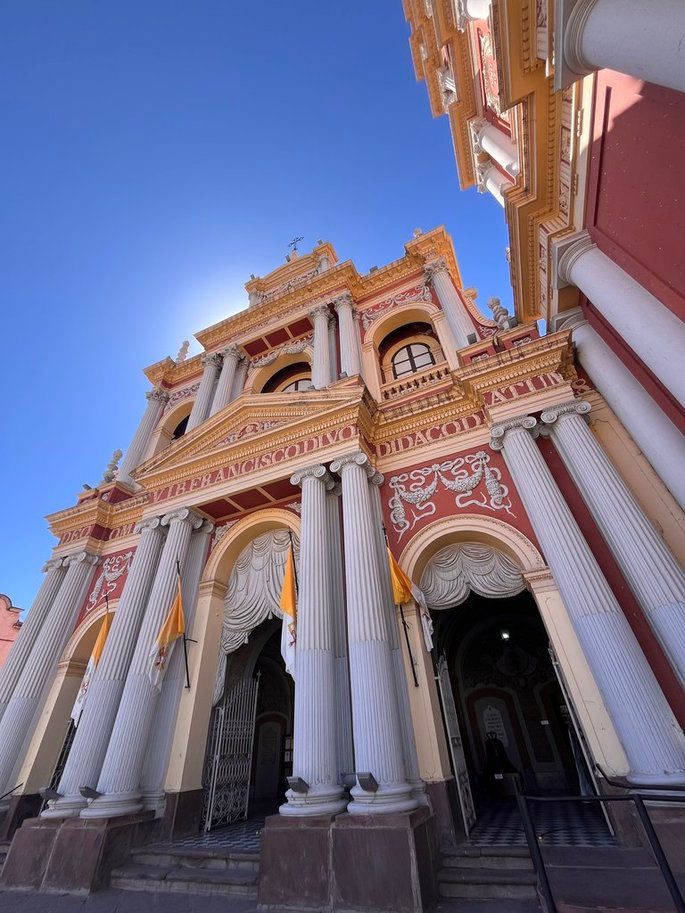
You pay for a guided tour that takes you through the interior and up into the bell tower. It’s conducted entirely in Spanish, however, which meant I had to concentrate hard and translate everything in real time for my parents. We started off in a peaceful inner courtyard, enjoying the scent of roses blooming in the garden.
Walking through the surrounding rooms, we saw a collection of holy relics containing bone fragments from various saints. Our guide explained that these are classified as "first-degree relics" because they consist of actual physical remains. Second-degree relics are items once owned by a saint, while third-degree relics are objects that have touched a first- or second-degree relic. Interestingly, this entire collection was privately owned by a prominent local family who eventually donated it to the monastery.

The tour then led us upstairs and through a secret passageway concealed within the side wall of the church. This corridor emerges directly into the main nave beside the organ, allowing priests to move to and from services without coming into contact with the general public. More dramatically, the passage was used to shelter local townsfolk during a brutal invasion in 1867: terrified citizens fled to the monastery, where the friars hid them inside the thick walls.

The tour culminated at the bell tower. Its construction began in 1870 when an Italian Franciscan monk, Fray Luis Giorgi, brought in architects to build a record-breaking, 54-metre tower. It was finally inaugurated in 1882 — exactly 300 years after the founding of Salta. Reaching its base, we climbed around a hundred tight, winding stone steps followed by two ladders to reach the first set of bells and the view.
Decaying wooden ladders continued further up to the top of the tower and additional bells, but these were no longer safe to use. The massive bronze bell we reached weighs 1.5 tonnes and was cast by melting down weapons from past conflicts — if you look closely, you can see that the clapper inside is actually a repurposed cannonball.
After an intense hour of continuous translating, we went to grab some empanadas at a local cafe opposite that our guide had recommended. He had promised cheap, authentic food, but to us it seemed fairly expensive — and there’s only so much excitement you can squeeze out of a plain cheese empanada!
We finished our day of culture by visiting the MAAM (Museo de Arqueología de Alta Montaña). This museum was built specifically to house the "Children of Llullaillaco" — three Inca children who were sacrificed over 500 years ago. Because they were entombed at 6,739 metres (over 22,000 feet) on the freezing, hyper-arid summit of a volcano, their bodies never mummified into skeletons. Instead, they naturally freeze-dried. When they were discovered in 1999, their internal organs were intact, blood remained in their veins, and their skin looked as though they had fallen asleep just the day before.
Visitors can never see all three mummies at once. To prevent the remains from degrading, the museum engineered an extraordinarily high-tech, custom cryopreservation system. The mummies are housed inside specialized glass capsules maintained at -20C (-4F) with precisely controlled atmospheric pressure and oxygen levels. Because light exposure causes cumulative damage, the museum puts only one child on display at a time, rotating them every few months. In addition to the lighting, camera flashes degrade ancient textiles and organic tissue over time, so photography inside is strictly forbidden. The photos included here depict what we saw, but are official museum images rather than our own.

During our visit, we saw La Niña del Rayo (The Lightning Girl), shown on the right above. Her sacrifice was performed as part of the Inca ritual known as Capacocha. This was the most crucial ceremony in the Inca world, serving multiple political, religious, and social functions. Children were selected for their physical perfection and noble lineage, as their sacrifice was believed to appease the deities. The ritual was also carried out to mark the coronation of a new emperor, mourn the death of a ruler, or solidify alliances across distant territories.
While to us it seems horrific, it is important to understand that this was not a punishment. The Incas believed these children never truly died, but rather ascended to become eternal divine ambassadors. The fact that the children were heavily sedated with coca leaves and maize beer (chicha) — slipping into unconsciousness before hypothermia took hold in the extreme cold — shows that the Incas treated them with profound reverence, even in death (especially if you compare it to how Aztec sacrfice took place).
The children were not buried alone; they were accompanied by over 100 exquisite miniature ceremonial objects. These items were carefully crafted to represent the roles the children would assume in the afterlife.
It was certainly an educational and thought-provoking day out.


Comments