
Perito Moreno Glacier
After finally getting a good night's sleep and resting up our tired legs after Torres del Paine, we continued to move north. Despite the temptation to leave the Ruta 40, we decided to stay on it all the way to Esperanza. Once there, we nearly doubled back on ourselves; the road here completes two sides of a triangle (and a big one at that) in order to continue on towards El Calafate. While you can leave and take a shortcut on the Ruta 7, comments about the very poor road conditions had put us off. We decided to take the long way round and stay on tarmac, rather than the detour which was half the distance but probably unlikely to be much quicker. I mention it, as this route is important later.
We decided to camp just before El Calafate, on the beautiful river. Funnily enough, this was the very same river we had camped near on the other side of the country. Remember when we hiked out to the penguin colony in Punta Quilla? Well, this is that same blue river we camped at the night before. Now we picked it up again on the west side of the country. Over here, it’s even more stunning. Its immense pastel-blue waters cut a dramatic path through the landscape. It’s one of those things that you’d see photos of and think someone had put an overly dramatic filter on it. But no, it really is that colour. The reason for this is its origin. The river itself is certainly beautiful, but the glacier feeding it is out of this world.
Since we had been in Argentina, the prices of the national parks had gone up significantly. It’s now $45 per person (if you’re a foreigner), approximately five times the price of a ticket for an Argentinian. This is obviously a big hit. We don’t have $90 to casually spend. We decided that with the new pricing, we’d have to be very, very selective about what we went to see. While a lot of places wouldn’t make the cut, this glacier was at the top of my list.
As much as I was excited for the glacier, I also wanted to spend a couple of days at this gorgeous river spot. Our friends had sent us the location, saying it was beautiful, and I couldn't agree more. We pulled down off the road onto the shore, setting up camp right at the water's edge. It was blowing a gentle breeze and the sun sparkled off the water. It was a beautiful day. Having easy access to fresh water for the first time in a while was the perfect opportunity for me to try out our new water pump and then use that to do all the laundry.
Everything was peachy until 3am. And then, you’ve guessed it, the wind came. Out of nowhere. It was so bad that we decided to try and drop the roof. This, in itself, broke the roof even more. It was now impossible to lift the roof at all. The camper was a tip and it was basically impossible to sleep. As much as we’d had a horrible night, I didn’t want to leave the nice river. So the next day we decided to try and set up the downstairs bed and spend a night sleeping downstairs. The amount of stuff that needed to be moved to achieve this was ridiculous. With the bed out, it’s impossible to do anything in the camper. Sleep didn’t go a whole lot better downstairs either because the bed itself isn’t wide enough for two people, so we had to try and sleep in a kind of staggered arrangement. I crawled outside in the morning and declared, “Never. Ever. Again.”
If we wanted to stand a chance of sleeping that night, we needed to get new roof bars made, so we packed up and headed into town. I had thought about making some new ones from copper piping, mainly because I could do it myself, but a lot of countries down here don’t use copper piping like we do in the UK. Oddly, you can buy the fittings — elbows, connectors, etc. — but not the pipes. So we headed to the biggest hardware stores in the rather remote town to see what we could find. The first shop’s only likely-looking pipe was a curtain rod, but it was a bit on the thin side and we weren’t convinced. It was also pretty pricey, as we’d need to buy four of them and waste a load due to the length they came in.
The people in the next shop we tried were very nice. We showed them our broken remnant of pipe and the man disappeared into the warehouse before returning with steel conduit for cables. It was exactly the right diameter, which was important because it had to fit into the pre-existing connectors on the roof. We hadn’t planned to use steel as it was a lot heavier, but at least it was also a lot stronger. It was covered in a kind of gooey bitumen paint to protect it, but we could take that off. It was also incredibly cheap. We bought two lengths for about £10. The only thing now was to find someone who could bend it for us.
There wasn’t a huge amount of choice in town. We drove around to one metal workshop that didn’t exist before heading over to the other side to try another. Here we were greeted by the friendly Pablo. We showed him our old broken bars and the new steel ones. He was very obliging. He told us they’d be done in two hours, which was amazing news as it meant we’d be able to go to bed that night. In the meantime, we headed off to sort out more problems. Namely, the cat.
We’d let her vaccine lapse and we’d need to get that sorted in order to get new papers to re-enter Chile. We tried the closest vet, which we thought was a bit on the pricey side. Then we went to another one, which was a little bit cheaper, so we got both the girls sorted. She also backdated the vaccine for us, meaning we’d have no problems with the health certificates later. By the time that was done, our bars were nearly ready. We headed over there to wait for them, but as we turned up he was already waving the new ones at us. I tested the fit in the connectors and confirmed they were the right size. They looked perfect, in fact. We were delighted — cheap and fast, what more could you want?
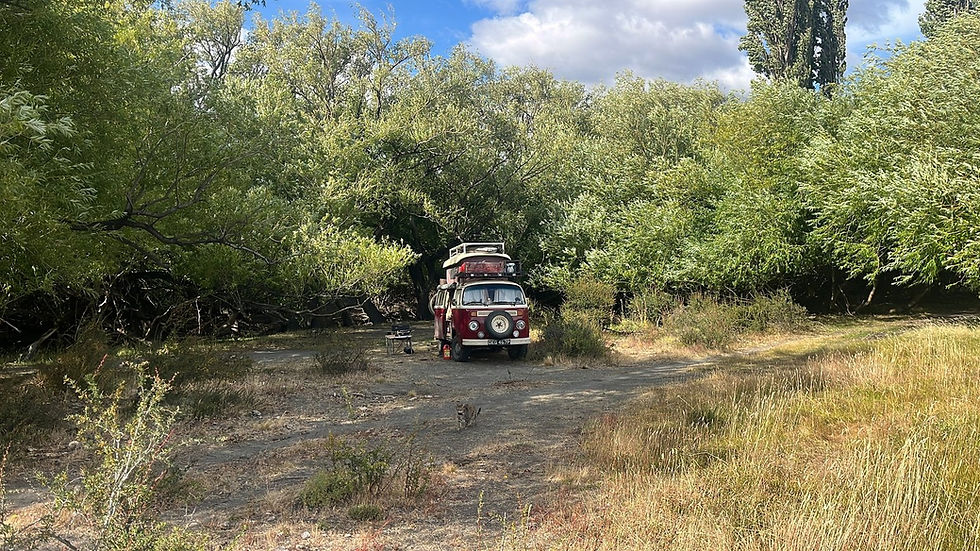
We decided that we would camp out of town near the glacier, and so we continued on. We headed for the only place that looked like it would have wind protection: a clump of willow trees in a small dell in a field. It seemed we weren’t the only ones with that idea in mind and two other vans were already down there taking up most of the accessible spots. We camped higher up the hill, hoping it wouldn’t get any windier, and I set about installing our new bars. It’s a simple job of drilling a couple of holes in the bottom to screw the connectors to the metal, as Pablo had already attached the main pivot bolts. It wasn’t long before our roof stood once again. The wind here was still quite strong, but with the new bars the roof held steady. The old ones had worn on the pivot point until the holes were big and oval, which caused a lot of slop in the roof. The new ones were a great improvement and we felt much more confident. So much so that we slept up there in much more wind than we normally would have managed.
We had decided that we would hang around here for a few days. Money was tight and the end of the month was coming. We decided we’d stay here for the remaining five days until we got enough money to fill the fuel tank and move on. In the morning, the campers who had been at the bottom of the hill left and we crept down and tucked ourselves into a perfect little spot that offered great wind protection but didn’t block our solar panel from the sun.
That night the wind returned in full force. It screamed through the trees behind us, waking us up with its sheer volume. We braced ourselves for the hit that never came. We were well protected down here, in this dense little copse with trees on three sides and the hill on the other. Despite that, it was still hard to relax hearing it batter the trees around us.
I had decided that we’d try the “student trick” to get into the national park at the student rate. Our friends had told us that apparently if you show any letter stating you’re in education, you get in for the student rate which is only about £5. I was very up for saving £70, so I fabricated some “student letters” and bought student tickets on the website. We were all set up to go the following day. We had heard it’s best to get there when it opens at 8am, so you can enjoy it for a bit without the tour buses full of people.
Now, this is the moment when that Ruta 7 we avoided driving down earlier becomes relevant. We were in contact with another British guy on a motorbike who was nearby. Our routes had coincided here and he told us he’d come and camp with us that evening. Sure enough, before too long a large bike came into view on the ridge above and made its way down into the clearing.
Its rider eased himself gingerly out of the seat and introduced himself as Mark. He explained that he’d just had a nasty fall off his bike as he took the aforementioned shortcut. He said he was lucky not to be seriously hurt, having completely flipped the bike end over end. Both he and the bike looked a little worse for wear. We grabbed him a chair, leaving the rather battered bike parked up next to Ruby. He was not in the chattiest of moods, understandably, so we gave him dinner and some painkillers and he slowly assembled his tent and hobbled inside for the night. I didn't envy him sleeping on a little foam mattress in a tent after what he'd been through.
The next morning, we headed off to the glacier. It’s still around a 45-minute drive away, even though we were only about five minutes from the entrance. We sailed through on our student tickets, cats unnoticed. Then we drove the long entrance road which finishes when the land runs out, directly at the glacier. If you go early enough, you’re allowed to park in the top car park which is much closer to the main walkways. We were among a handful of cars in the car park. We grabbed the camera and headed for the viewing platforms.
There is quite a large structure of platforms and stairs mounted into the riverbank. They all offer views from slightly varying angles out towards the glacier itself.

I have never seen anything like it. We stood entranced at the edge. As the morning sun hit the ice, we heard it cracking. You might think it'd be still and silent. But it’s almost alive. It cracks and creaks and then, from time to time, chunks from the edge break free and dive into the bright waters.
Its 5km-wide ice face stands around 60m high. It had been famously celebrated for decades as being one of the world’s only stable and advancing glaciers. However, that is sadly no longer true. In just five years, between 2019 and 2024, the glacier retreated by more than 800 metres. Not only that, but it is also currently thinning. Before 2019, it was thinning by around 34cm per year, but this has since accelerated dramatically to between 5 and 8 metres annually. A scientific study concluded that it is no longer attached to its bedrock and is now essentially free to move. This additional movement causes further break-up of the ice. While it is not in danger of completely disappearing, at least not in our lifetimes, it is moving steadily further away from the viewing platforms. Although, given the way Argentina is, they’d probably relish charging us all more for a boat tour to get closer.

We spent several hours admiring the impressive view and incredible collapses as huge chunks fell into the river. The beautiful autumn colours set off the colour of the blue ice against a backdrop of orange and red leaves, while a rainbow appeared in the background. It is literally one of the most beautiful things I have ever seen.


Comments