
The Realities of Argentinian Inflation
Updated: May 25
After spending several months in the “most expensive” Latin American country, we were excited to return to cheaper Argentina. It may still be a lot more expensive than it used to be, but on our previous visit from Chile we had certainly noticed cheaper grocery shops. It had only been around three months since we were hanging around in Buenos Aires, and you wouldn’t think that prices could change so fast. We headed to the Carrefour we had visited just before we left for Uruguay and were disappointed to see that many things, like cat food, had got significantly more expensive. At least we could stock up on cheaper fuel, and we consoled ourselves that this border supermarket had always been pricier than the rest of the country.
With food stocked up, we debated where to camp. It was a rainy and unpleasant day. The almost oppressive heat of the last two days had ended in a storm that lashed the town with rain. After getting soaking wet just getting back to the car with the shopping (we couldn’t bring the van into the car park because of the height limit), we decided against the river spot. Not just because of the risk of flooding, but also because parking there was in long grass and we didn’t want to get stuck. There weren’t too many options, and in the end we parked up in a large empty concrete space by the banks of the river in the centre of town. It didn’t really matter where we were, as we had no desire to go outside. It rained heavily and steadily throughout the night, and when we awoke the following day it was significantly cooler.

Now we had some long drives ahead of us to reach Laguna Gomez and our scheduled VW meetup. I had confirmed our attendance now that we had successfully crossed the border, and while we still had a day until the event started, we decided to push ahead. It seemed pointless to stop somewhere for the sake of it. If we made it there today, we could spend a day relaxing on the lake and not worrying about a last-minute breakdown. It took us most of the day to complete this nearly 400km trip, and we arrived tired but successful towards the end of the afternoon.

We hadn’t been at the lakeside long when a white pick-up stopped. It was some of the people arranging the event, and they had recognised us from the dedicated WhatsApp group. The back of the truck was loaded with firewood, and they were very pleased with themselves. It looked like, unsurprisingly, there was going to be a huge barbecue. While most people wouldn’t arrive until the following day, one very excited Kombi owner was on his way right now. He arrived shortly after dark, and we met Diego and his little dog. This is clearly an event they look forward to all year, and he was happy to show off his Kombi and spend the night camped next to us on the lakeside. I didn’t feel ready to be sociable yet; mentally I was prepared for tomorrow—the endless questions, the still-present language barrier, and the exchange of stickers. After a very long drive we just wanted a quiet night, so we were slightly relieved when Diego went off to have dinner with friends and left us alone.
The following day we were told we could move around to the campsite whenever we wanted. Having arrived late the previous day, we first headed into Junín to stock up on alcohol for the weekend as well as some fresh fish to put on the barbecue ourselves, before driving back and camping. Several people were already there. We positioned ourselves on the outskirts so we could choose how involved to be. Sometimes it can be a little overwhelming.
In dribs and drabs, other campers arrived. We got to poke our noses into everyone else’s Kombis, and equally we let everyone look at Ruby. The roof conversion and the engine were particularly hot talking points. Then a blast from the past arrived. We knew they were coming as they had messaged previously in the group, but it was still surreal to see their camper pull in. The last time we saw that vehicle was on a campsite in Minca, Colombia. Freshly arrived on the continent, we had been there in our own van for only a week or so. We joined several other overlanders up there, hiding from the intense heat of the Pacific coast. At the time our Spanish had been very limited and communication was a struggle. Now we were excited to catch up on two years of travel properly. It was crazy that with no planning or communication, we were both here again in the same spot two years later.
It was no surprise when the fire got going. Diego was the star of the night. He had with him half a cow and a bottle of his magic seasoning. He mounted the huge piece of meat on a big metal rack and spent several hours meticulously basting and rotating it until it looked perfectly cooked. But that was only the warm-up.
There was an order to events here. The next day we were scheduled to head into town for a kind of “show and shine”. Our campers departed around mid-afternoon, a long string of Kombis driving down the road.
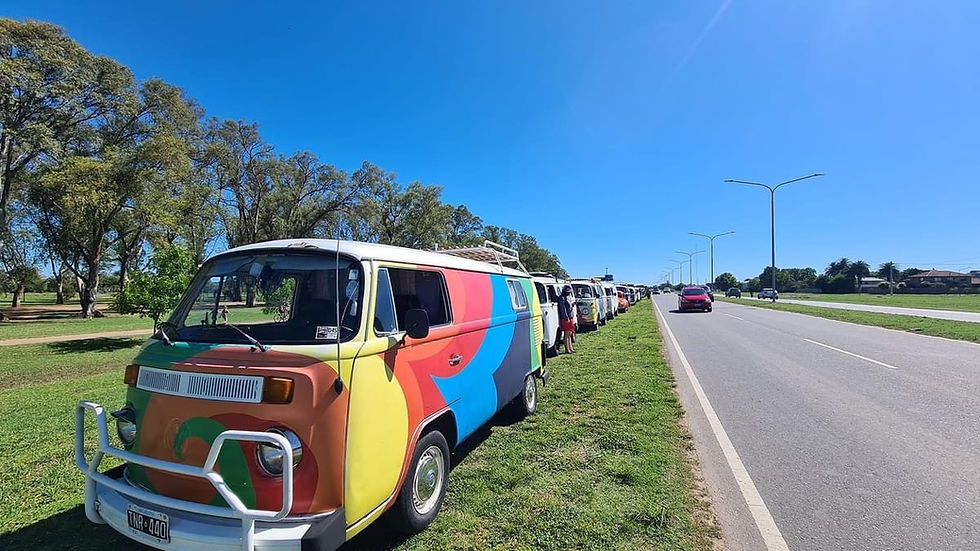
We parked up around the village square in a line and were bombarded by townsfolk. The mayor wanted to talk to us. The tourist board wanted to interview us. It was all going on. We definitely felt like minor celebrities for a few hours.
Afterwards, we headed back to the campsite for the main event—the big asado night.
The firewood was brought out. A sound system made from the front panel of a bus was set up, and the barbecue was loaded. Everyone had something. We placed our fish on the sides—the odd ones out. Still, at least we had something to barbecue. I can only imagine the outrage if we’d gone and cooked something vegetarian. Everyone pulled chairs up around the fire while the meat cooked, and the drinks and conversation flowed. They also did a raffle in which we won some rather tasty salami—about the only meat I have discovered that I actually enjoy eating.
It was a late night, as you might imagine, and while I had wondered if it would all be a bit much, it was perfect. Everyone was relaxed and chatty—friendly but not pushy or overwhelming. We had a great evening, and it was nice to have a level of Spanish that allowed us to chat with everyone without much trouble, for the most part. A year or so ago, I’d have been wiped out after half an hour of that. These days it’s almost hard to remember how tiring it used to be—straining for each individual word and carefully thinking through every reply. I was definitely enjoying getting more fluent.
Sunday morning was a slow start, as expected after a heavy night. Someone came to the van to tell us that the facturas were ready if we wanted breakfast. This confused me at first; to me, “la factura” is a bill or receipt. Here in Argentina though, facturas are similar to French pastries—little sweet glazed croissants, slices of puff pastry filled with mermelada de membrillo (a firm quince jam). Some had custard inside, others were filled with dulce de leche, which is basically caramel. The Argentinians certainly have a sweet tooth, and all this needed was a good coffee—something they don’t really do. Still, we of course accepted the rather strong instant coffee and focused instead on the pastries; they were delicious.
The end of the meetup was at the lake. By now some people were packing up and leaving, but those who still had time moved out of the paid campground and back to the lake. We debated staying on, too lazy to pack up, but when we heard the normal price we were soon back out at the lake with everyone else. We sat in the glorious afternoon sun on the grass, the bright blue lake as a backdrop behind us. The Argentinians enjoyed their mateado—the ritual of drinking mate, something taken very seriously. Slowly the leftover pile of facturas dwindled, and we joined in drinking some fernet. Mate is the daytime drink; fernet is the alcoholic one—a bitter black liqueur that tastes almost medicinal and is mixed with cola. The usual ratio is 30% fernet to 70% cola, and we now had a sign in the van to remind us of that if we ever forgot—a gift from fellow campers.
Towards the end of the afternoon most people left, a few needing a helpful push to get going, as you might expect from a Kombi meetup. We thanked the organiser for inviting us; it had been a really great weekend. As it was getting late, we decided to stay where we were. We were joined by our Colombian friends as well as someone else who made his living travelling in a truck camper, demonstrating and selling camping equipment. We camped together in a line and enjoyed a peaceful, quiet, early night.
We had planned to leave the next day, but in the end stayed one night longer. I was in no particular hurry, as our next stop would be back to Buenos Aires to fix a few niggly issues with Ruby before the big drive south. Last time we hadn’t enjoyed camping in the capital, and staying another day by the lake in the sun felt far nicer. Carlos and Marce headed off, but we were sure we’d see them again soon enough down the road. Like many other overlanders, we all had our sights firmly set on reaching Ushuaia within the next month or so.


Comments