
From Encarnacion, Paraguay to Posadas, Argentina
- willowrolfe
- 5 days ago
- 6 min read
Updated: 4 hours ago
After the workshop the previous day, we had a quiet night. Lee was a bit down after watching England’s defeat in the World Cup, and we were glad we hadn’t gone to Argentina to see that particular match. Having celebratory Argentinians all around you would no doubt have made it a whole lot worse! The only plus side was that as we were now out, we could go and watch the final between Argentina and Spain in Argentina itself. We imagined there would be quite an atmosphere! Our friends were already in Posadas, having crossed the day before to watch the England game, and we said we’d meet them there on Saturday. That meant we had two days to cross over the border, which was just 40 minutes away.
The reason we delayed was the wind. Our next, and final, night at Puerto Obligado brought not only gale-force winds but also a party. They partied — with thumping bass — in a quincho (a small shelter, normally including a barbecue, seating, lighting, and a sink) next to us until 4 am. I’m not sure we would have slept well without them anyway due to the wind, but the combination made for a horrible night. We awoke in the morning to see the whole floor strewn with bottles and rubbish, despite the fact that there was a rubbish bin just metres away. Those kinds of people.
On the recommendation of Elvio, we decided to go down to the next little port on the river, Puerto Cantera. It’s about as far away as the border, because to reach it you have to follow some dirt roads down to the river where the main road starts to bend away. We hoped it would at least be quiet and free of people. The wind was coming off the land before blowing across the Río Paraná and hitting the Argentinian bank. This was where our friends were camping, so we imagined it was even stronger over there, having picked up speed as it blew over the empty 2.5 km stretch of water.
Elvio told us that entry to this spot was paid, but only around £1 per person. When we arrived, we saw the sign on the gate stating this as the entry price. The gate, though, was closed, and we couldn’t see anyone inside. We sat outside, looking at the map to see if there was anywhere else in the area. Then there was a small clunk, and the gate opened. We saw a man standing over by a large building. We drove inside and went to speak to him. He said we could camp, but that it would be 30,000 guaraní per person. As we were the only people there and the gate would be locked at night, we agreed in the hope of getting some sleep.
We had free reign of the area: a pretty little piece of land with small trees dispersed between nice little barbecue areas. The place looked new. The sinks had potable water, and the electricity here worked properly. The only downside, really, was the wind. It howled across the flat grass, bending the poplar trees double. We tucked ourselves into the most sheltered spot we could find, hoping it would die down later.


Only one other car came that day. A family got out, mate thermos in one hand and fold-up chairs in the other. They set up their seats on the little grassy spit just in front of us, turned their backs to the wind, and sat there with a grim look of determination. They didn’t last long, though, and soon it was just us alone for yet another incredibly windy night. It was so strong that it blew our folded-up table off the picnic bench outside with an almighty clatter that had me out of bed at 4 am to rescue it.
The next morning, not refreshed at all, we set off for the border. Before we crossed, we had one final job to do, and that was to buy some new tyres. Ruby’s were on their last legs, and while they weren’t totally gone yet, we had no good spare. We were one irreparable puncture away from an expensive mistake, considering we were heading to Argentina next, so we bit the bullet and decided to get some new ones.
We headed to a likely-looking tyre shop in Encarnación, the border town that lies on the other side of the enormous bridge linking the two countries. Happily, they had suitable tyres at a very reasonable price. We swapped them all around, keeping the best existing one as the spare and putting the two brand-new ones on the back. The staff were very friendly: one guy was keen to practise his English, and the other chatted away as he swapped them over. They didn’t mind my intervention with a torque wrench, either, when I saw them about to air-gun the wheel nuts on at the end!

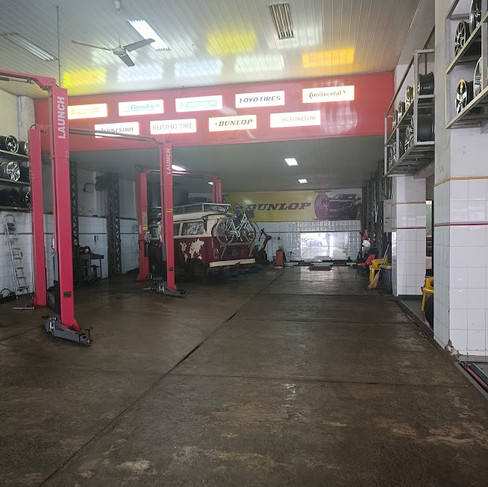


We had expected to search much longer to find tyres, as we have very small (14-inch) wheels, so we were actually ready to tackle the border crossing sooner than expected. We pulled over and put the cats in their rucksacks, hiding them in the back. Then we drove to the bridge where we had met the unpleasant security guard a few months before. Luckily, he was nowhere to be seen.
While Lee loitered by the side of the road, I ran in to hand in the vehicle papers. I wasn’t sure what to expect. Last time, we had been issued a TIP by this office for only one month. When we were at the border around my birthday, we had chatted to the office there and asked if we could change this to match our three-month visas, as we had decided to stay longer. I had expected them to issue us new papers, but instead, the officer told me he’d ‘do me a favour’, stamped out the ‘exit’ side of the form, and dated it three months in the future—giving us a total of 4 months. No one had stopped us yet to ask for our documents, but I wasn’t sure what they’d make of this. It wasn’t the ‘normal’ way to do things, and I could only foresee problems.
I geared myself up to explain the situation as I neared the white shipping container that served as their office. I asked the nearest person for the right official and was told to wait while he finished searching a car just in front. Then he walked over to me with a friendly smile. “Another three months, is it?” he asked without prompting.
“Erm, no actually, I’m going to Argentina,” I said.
“Right then.” His smile widened as he plucked the folded document from my outstretched hand. “¡Buen viaje!”
“That’s it?” I checked, as he hadn’t even cast a cursory glance over the still-folded paper.
“Sure! Have a nice day!” His smile widened as he waved me off.
I wasn’t going to argue. I walked back to Ruby and hopped in. “Did it go okay? Were they funny about it?” Lee asked me.
“Literally, he could not have cared less. It couldn’t have been easier,” I said. “Let’s go.”
We continued onto the bridge itself. At this particular border, all the other formalities are completed on the Argentinian side. We sat in a slow queue for nearly an hour on the bridge as it inched forwards. The wind still howled, buffeting the van around as we sat exposed on all sides. I started to worry a bit about the cats stuck in their bags in the back; it was a hot day, and we hadn’t imagined they’d be in there so long.

Eventually, it was our turn. We passed the first booth, where we got our passports signed out of Paraguay and into Argentina. Then we moved up to the next booth, where they had been searching all the cars. They waved us to a parking space at the side. A young lady walked over and asked me to go into the office to process the vehicle papers. “When you’re finished,” she said, “we’ll check the van.” I went to do this and saw out of the window as I waited that she was already checking the van with Lee. Then she walked off, so I assumed the cat-smuggling mission had gone smoothly!
With everything sorted, we drove off a short distance, and then I climbed into the back to release the girls. They were completely unfazed; despite me opening the bags, they chose to stay sitting inside!
We drove about half an hour out of town to meet up with our friends, who were camped on the riverside at Playa Puma. We watched the France v England match for third place in the World Cup, and it seemed the wind was dying down so we could actually enjoy sitting outside in the sun. After the match, we cooked a simple meal of spaghetti bolognese and garlic bread together, which we ate inside their van to escape the wind, which had reappeared at full force once more.


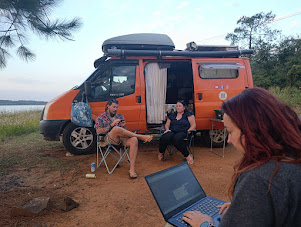


In an attempt to sleep better, we made sure nothing was left outside. We dropped the front of the pop-top before going to sleep to minimise the rocking of the van, and put in our earplugs. It was a little better, but still not great. Pop-tops really aren’t the best for camping in high winds, and it brought back memories of the months spent in Patagonia searching for forests and buildings to shelter behind!


Comments