
Colonia del Sacramento
We were a bit on the late side leaving Montevideo. By the time we had visited a supermarket, packed the final things and stocked up on fuel and pet food, it was the end of the afternoon. This meant that after a three-hour drive, we arrived back at our lovely little lakeside camp spot in the dark. Deciding we would rather not risk driving through the very sandy section at night, we took a longer route and entered around the back of the little lagoon. Rather than sandy, this road was muddy and flooded. It also had several birds sleeping in the middle of it, all of whom had a narrow escape. After creeping slowly around, we arrived back at our original spot, perched on a small rocky outcrop on the water’s edge.
The following morning, we awoke after a silent night to the gorgeous view. The only thing that spoiled the day was that the Wallas decided not to turn on. We appeared to have some entirely new fault. This was pretty frustrating after just paying quite a lot of money for a service. Luckily, we still had our backup camping stove with a little fuel left in it.
We had only planned on staying one night and that definitely would have been our limit if the cooker hadn’t reluctantly fired up later that evening. It seemed to be some kind of loose connection, but we were glad to have it back, especially as it wasn’t particularly warm and we enjoyed a bit of heating while cooking dinner.
Over the next few days, we managed to get it working intermittently. Enough, at least, that we were able to stay on this spot a little longer. The weather was not as stable as it had been previously and, with storms passing through and a lack of sunshine, we were eventually forced to move on and camp within the town itself.

As far as free city camping went, this was a pretty good one. There was free electric hook-up, toilets and water; perfect for us and our low batteries. It was a huge car park next to the local football stadium and, most of the time, it was relatively quiet. The cats could roam freely and we could easily walk into town.
For the first time since Peru, we met up with Enzo and Gaby. If you thought we lived in a small van, wait until you see Pachita. While they lived in this tiny little conversion, they somehow still had space for musical instruments and an amplifier. Most days they headed down to the seafront to busk. With the beautiful sunset, the skyscrapers of Buenos Aires just visible across the Río de la Plata behind them and a constant stream of passing tourists, it was easy to see why they had already been here for several months.
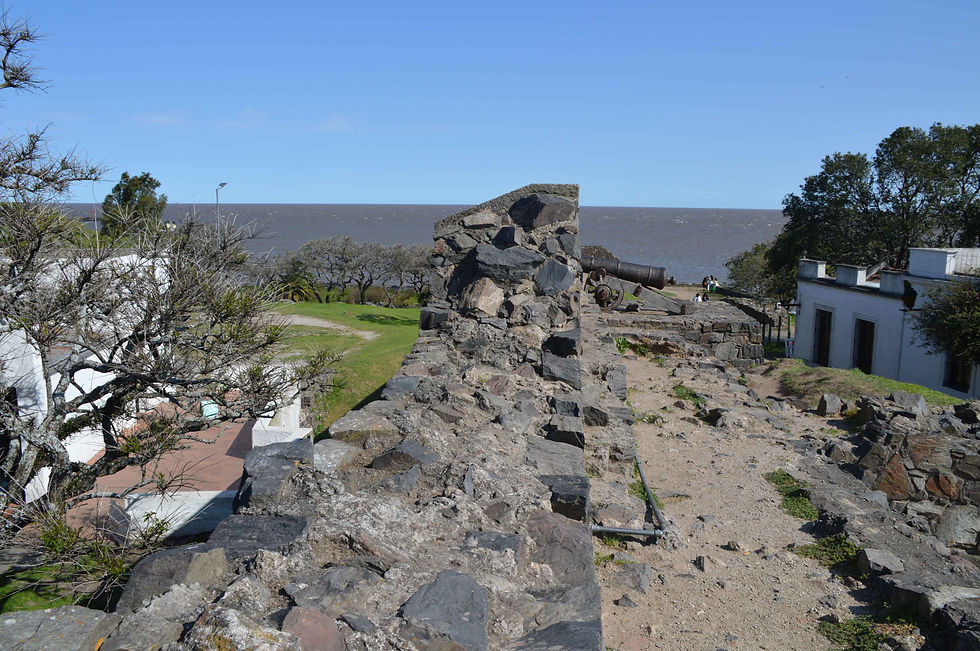
On the whole, our free parking spot was fairly quiet and so we were able to enjoy several lovely days in this beautiful town. It is a UNESCO World Heritage Site and, as you walk the cobbled streets past the crooked houses, it’s easy to see why. History seeps from every pore of the place. On our first day, we wandered around the main sights. We visited the old ruined city wall, complete with cannons and a drawbridge. Once held by the Portuguese, who established the town back in 1680, this heavily fortified wall stood as the settlement’s main defence. The other three sides were protected by water, where cannons still stand guard facing the river.
The most photographed street in the whole town is probably Calle de los Suspiros, or the Street of Sighs. Tales vary as to how it got its name. Some suggest it once housed several brothels regularly frequented by local sailors, while another theory claims it was where doomed prisoners were led before being drowned in the river. Whatever the truth, today it is simply a picturesque little street adorned with a beautiful plaque bearing its name. While there were many other pretty things to photograph, we first headed to a local restaurant for lunch. We rarely treat ourselves to eating out, but we were tempted in by the promise of a vegetarian milanesa and some local beer.


Now fortified for more walking, we climbed the lighthouse for a panoramic view of the town before wandering back along yet more picturesque streets, full of bright colours and thriving plants.
For a breathe of fresh air the following day, we headed out of the town and walked down the river.
Uruguay is not a country that gets discussed particularly often amongst the travellers we meet. We hear that it’s expensive and a more ‘westernised’ country. The main reason people seem to visit is through necessity, as its port is often the starting or finishing point for many overland journeys. What no one ever mentioned, though, was the beer. It turns out there are many very good and surprisingly reasonably priced local breweries here. After only having a few beers in Argentina that I would describe as rather bland and expensive, this was quite a novelty. Over the next few nights, we visited several bars, quickly discovering that our favourite was called Barbot. They had a huge selection of interesting and very good beers. Even on our final day, we couldn’t resist popping in for one quick half before leaving.


Comments