
Argentina: Country 14
We were so relaxed in our new river spot that we just couldn’t bring ourselves to leave.
The following morning we awoke to glorious sunshine and, as the cats enjoyed being back in the wild again, I set about doing the huge pile of clothes washing. It took me several hours down by the river, but with a good breeze and a beautiful sunny day, things were drying in no time.
I had put my bikini on, with a good layer of sunscreen, to try and top up the tan. As I hung up the last few pieces of washing, my skin started to feel a bit on the tight side and so I popped on a T-shirt. The UV level here was at about 14, not something to be trifled with. Unfortunately for me, Lee had missed a few spots applying the sunscreen. They weren’t big, but over the next few days I got some serious blisters and probably the worst sunburn I’d ever had. Thank goodness it was only a tiny patch, as that in itself made sleeping hard and bras a definite no-go.
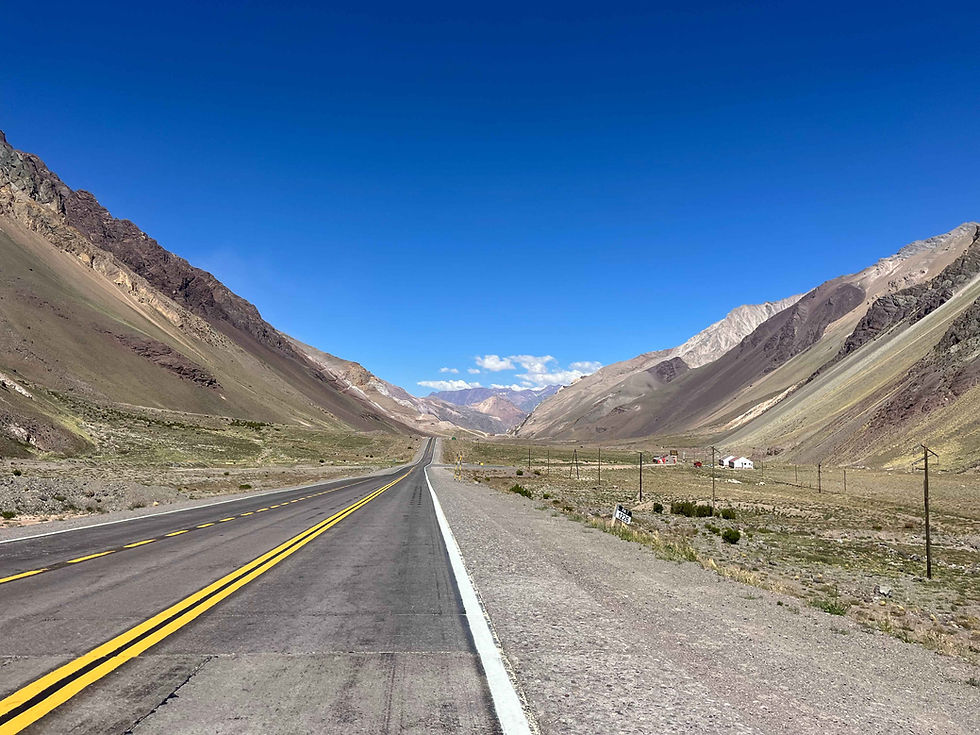
It was hard to stay out of the sun here. There were no trees, no shade and every day brought a brilliant blue sky. Not that I was complaining, but part of me wished we had bought an awning in Santiago.
The one day it rained, we drove into Uspallata for some groceries. We had no cash and so we couldn’t shop at the local veg shop, but had to make do with some canned things from a small supermarket. Here in Argentina, money is not so straightforward. Normally you can just visit a cash point, but here they have huge charges and poor exchange rates, meaning this isn’t really viable as a tourist. If you want cash, the easiest way is to send it to yourself with Western Union. This also gets you the ‘blue dollar’ rate. Argentina’s currency is so unstable that for years people have been investing in dollars as a more reliable way of maintaining the value of their money. Therefore there is the national exchange rate, around 950 pesos per dollar, or the ‘blue dollar’ rate, about 1,200 pesos per dollar. This is the rate you can get exchanging your dollars outside of the banks from people on the street trying to buy them as an investment. Western Union also offers withdrawals at this rate and so pretty much any traveller uses them to withdraw cash. We had yet to set up an account to do this and so, for the meantime, we paid by card. Luckily, this is now a viable option. Within the past year, Argentina introduced a much more favourable rate for foreign cards, meaning that it’s only around 8% more expensive to use your card compared to paying in cash. In the past, cards operated at the lower national rate. This meant you paid for everything in cash. Bear in mind that the highest value note here is 1,000 pesos, about $1, and a tank of fuel will cost you about 40,000 pesos. You literally need a rucksack to carry your money.
Back at the beautiful river spot, we moved slightly further down the valley, meaning we could park even further from the road. Here we had better access to the river as well.

With the return of the sun the next day, we set off to complete a hike to a waterfall further down the river. It was about a six-mile return trip, following the river up into the mountains. The only difficulty was the lack of places to cross and, as the water cut a path down the mountain, the rocks on either side meant that it wasn’t always possible to continue walking on the same side. We took off our shoes and socks and waded through. A refreshing moment on an otherwise hot day.
The walk continued up past some ruins, the signs faded and illegible. Apparently in the past it was some kind of refuge for people crossing the border, but now there wasn’t much to see apart from the remaining squares of the old foundations on the ground.
We continued up the valley, criss-crossing the river when necessary and enjoying the peaceful scenery. The only noises were the buzz of insects, the local birds and the rushing water.

As it was summer, there wasn’t too much water in the river, but at the top the waterfall was still there. We stripped off and headed into the perfectly clear, refreshing water for a cool down after our sweaty hike.

We had spent nearly a week in this lovely spot before we decided it was time to move on. We hoped to meet up with our friends in the near future and we also couldn’t wait to go to Bodega La Azul. This was a much-anticipated vineyard and restaurant we had been looking forward to for some time and so we made a reservation for the following week and decided to slowly make our way into the world-famous wine region of Mendoza.
Our next stop wasn’t far away, a lovely reservoir that stunned us with its bright blue waters from the moment we saw it. The little village of Potrerillos nestles on the side of this huge reservoir and we diverted briefly into town to fill up our drinking water supplies from a nearby free tap. Then we headed to a small peninsula a little further down, with an abundance of free camping options.

It was the summer holidays and so, despite the copious and clearly ignored no camping and no swimming signs, the place was full. We found a little spot to ourselves on the side of the reservoir and parked up. A few moments later we jumped into the water for a lovely little swim right by our door.
After two nights at the reservoir, we moved on. We decided that it wouldn’t be advisable to be there for the weekend and that we also really needed some cash at this point. With this in mind, we decided to camp in the municipal campsite at Tupungato. This would give us easy access to Western Union as well as putting us in a good location for our upcoming meal at La Azul.
We weren’t really travelling big distances and it was only around an hour to reach the town. We headed into Carrefour to do some shopping, pleasantly surprised by the lower prices after our time in Chile. The Western Union was also located just outside the supermarket and we popped in to ask how much money they had. We didn’t want to send more than they had available and not be able to withdraw it, but at the same time it made sense to send a large amount as the first transfer when you register, is free. They confirmed they had plenty of cash and so we went back to the van to unpack the shopping and set up our accounts.
We turned up just a few minutes after 1pm after sending ourselves a thousand pounds to withdraw. We hadn’t realised though that they close at 1pm. Not just for your usual hour lunch break either; they close until 4pm. Here in Argentina, there is one hell of a siesta. Back at the van, we got a notification that our transfer had failed anyway. It took us the best part of an hour to get our accounts authorised and the money sent and then we waited until they opened again.
This time, with the money confirmed, I headed to the counter to collect it. The lady behind the till began to count it out. After a few minutes, we decided we would need a rucksack. Approximately 1,600 notes take up quite some space! Now we finally had cash sorted, we headed up to the campsite and I pondered exactly how I was going to store all this cash in the van.
Another thing that seems exclusive to Argentina is municipal campsites. These cheap, government-funded places are popular with locals. The facilities may be somewhat on the tatty side, as we discovered later, or pretty clean and new, as was the case here. We paid about 4,500 pesos for the night, just over £3, for the both of us. There was hook-up, hot showers, a grill for everyone and potable water. It was an absolute bargain. The place was popular too, with people enjoying their typical Argentinian asados in the shade and kids playing in the very questionable-looking waters of the stream that ran along the bottom. For this price, I’d pay for camping more often.
It was a good time to get a nice hot shower in too, as the following morning we set off for our fancy meal at La Azul. Despite the fact that we had a reservation, we’d read you could turn up early and so we got there at about 1pm. We were shown to our table straight away by a friendly waiter who immediately plonked a bottle of wine in front of us and informed us that wine would be unlimited until 5pm. You don’t have to tell me twice. We got stuck in.
There was a choice here of either three courses or five courses. Being the greedy goblins that we are, we went for five, having already worked our way through the complimentary bread basket. We had empanadas, then Lee got a hot dog having gone for the meat option, while I had a huge salad in a cheese basket. All the while, the wine flowed.
For mains, Lee had the slow-cooked pork, while I had some rather interestingly coloured, but nonetheless tasty, ravioli. At this point, we began to regret choosing five courses instead of three.
Pudding came and we ate it of course, but we were then so incredibly full we couldn’t manage to move and go on the tour. We sat there and finished off the fifth bottle of wine while trying to digest far too much lovely food.
After a little effort, we dragged ourselves out of our seats and moved outside to sit with the cats and give them some company. On this roasting hot day, they’d spent most of it lying under the van on their leads, it being far too hot to keep them inside. Our waiter brought us a cheeky extra glass of rosé, which apparently wasn’t on our wine tasting menu, and also obligingly starred in Lee’s video.
Then, as 6pm came around, it was time to leave. Lee declared he would drive us 20 minutes to the nearest okay spot. We had planned to camp outside the power station just a couple of minutes down the road, but apparently he felt 20 minutes after a mere five bottles of wine wouldn’t be a problem. I was definitely not driving and the bodega didn’t allow overnight stays. We made it to a little spot just by the river, past the town of Manzano Histórico and while Lee apparently stayed up and had some beers (like the utter madman he is), I quite literally passed out on the front seats by about 8pm. What a glorious afternoon!


Comments